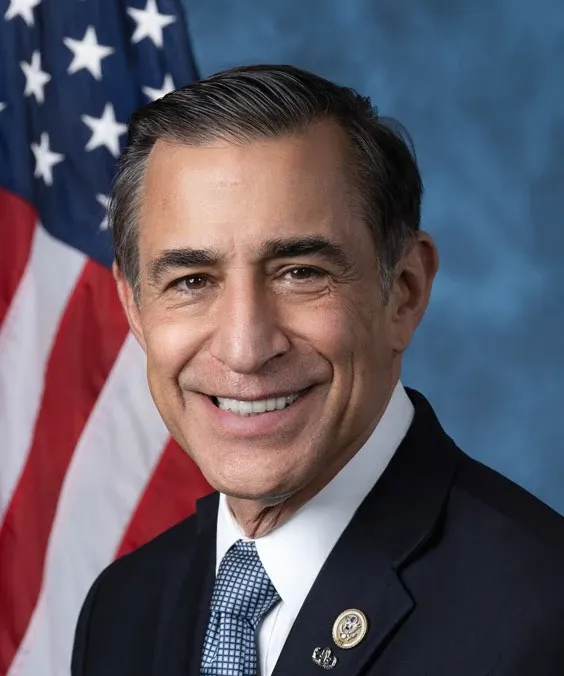
Tom McClintock
The Public Record
Thomas Miller McClintock is an American politician serving as the U.S. Representative for California's 5th congressional district since 2009. A member of the Republican Party, he has been an advocate for limited government and fiscal conservatism throughout his political career. McClintock has focused on issues such as tax reform, environmental policy, and government spending. He previously served in the California State Assembly and as a member of the California State Senate, where he gained recognition for his commitment to conservative principles.
Jun 5, 2012
I think we have run a follow of McClintock's first law of political physics which is the more we invest in our mistakes the less willing we are to admit them.
Jun 5, 2012
But going from theory to actual practice, I would look back over the 20th century and the beginning of the 21st century and I see Harding reducing spending as percentage of GDP in the early 20s, Truman reducing it in the mid-1940s, Reagan…
Jun 5, 2012
Sovereign debt default then would not be an act of the Congress, it would be a malfeasance of the executive and not prioritizing payments to ensure a timely payment of the sovereign debt obligations.
Jun 5, 2012
I specifically asked the head of their sovereign debt division if the budget adopted by the House last year, the so-called Ryan budget, would have preserved the AAA credit rating of the United States government. His answer was it would…
Jun 5, 2012
Can you offer us any examples of a nation that has ever spent and borrowed and taxed its way to prosperity?
Jun 5, 2012
But the deficits are future taxes. Whether you are taxing today, or you are taxing tomorrow, which is what we call a deficit, you are still taxing and those are the two ways that you pay for spending. So it seems to me, that with apologies…
May 30, 2012
First, I would like to remind the ranking member that the top 1 percent of income earners earn 17 percent of the income and pay 37 percent of the income taxes.
May 13, 2012
Fortunately, from what I have seen, the American public has awakened to the ramifications of these policies and has had a bellyful of them, and it is in the process of replacing the politicians responsible for them.
May 13, 2012
Representative McClintock spoke to that, and it was by 2001 that most of the big mills closed.
May 13, 2012
Now it seems the Federal Government has to pay you to remove timber from the public lands.
May 13, 2012
I am particularly interested today in suggestions of what needs to be done legislatively and administratively to unravel the paralyzing tangle of litigation, over-regulation, and endless deliberation that have misguided our federal…
May 13, 2012
The excess timber is going to come out of the forest one way or the other. Either it is going to be carried out or it will be burned out, but it will come out.
May 13, 2012
I again want to thank Congressman Scott Tipton for his leadership on these issues and for pressing to have this field hearing conducted today here in Montrose.
May 13, 2012
When the mills in my district closed in 2009 the owner made it very clear that although the economic downturn was a catalyst, the underlying cause was the fact that 2/3 of the timber they depended upon was held up by environmental…
May 13, 2012
Eliminating Federal red tape and excessive litigation is, indeed, the only path to create healthy forests, jobs, and abundant water and power supplies.
May 13, 2012
No picture I have seen paints a more vivid case for returning to these sound and proven forest management practices than an aerial photo of the Fraser Experimental Forest in Colorado a few years ago that is often called the Red Hand of…
May 13, 2012
The result is now clear and undeniable: economically devastated communities, closed timber mills, unemployed families, overgrown forests, overdrawn watersheds, jeopardized transmission lines, rampant disease and pestilence and increasingly…
May 13, 2012
I want to thank Congressman Scott Tipton for his leadership on these issues and for pressing to have this field hearing conducted here in Montrose.
May 13, 2012
Eliminating Federal Red Tape and Excessive Litigation is indeed the only path to Create Healthy Forests, Jobs and Abundant Water and Power Supplies.
May 13, 2012
Only in America will you have the government that pays, that actually gives grant money to environmental groups, and these same environmental groups sue the government.
May 13, 2012
And frankly, I would challenge the Republican majority in the House to bring that to a halt.
May 13, 2012
You can't blame the Senate or the President for that. All appropriations originate in the House.
May 13, 2012
We're told that there isn't enough money for forest thinning, and yet we used to have no problems keeping our forests thinned and healthy when we sold commercially viable timber.
May 13, 2012
This is not environmentalism. True environmentalists recognize the damage that is done by over-growth and over-population.
Politicians like Tom McClintock