Jun 23, 2014
I am very pleased to yield 5 minutes to the gentleman from Ohio (Mr. Johnson), the author of the companion House bill of this legislation.
The Public Record
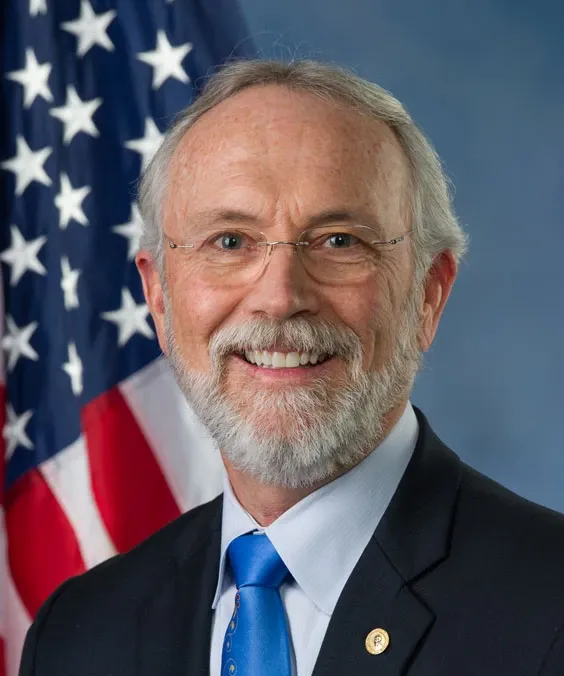
Doc Hastings is a former Republican member of the United States House of Representatives, representing Washington's 4th congressional district from 1995 to 2015. During his tenure, he served on several key committees, including the House Committee on Natural Resources, where he focused on issues related to energy and natural resource management. Hastings was known for his advocacy of agricultural interests and water resource management, reflecting the priorities of his largely rural district. He played a significant role in various legislative efforts, including those aimed at promoting economic development in Eastern Washington.
I am very pleased to yield 5 minutes to the gentleman from Ohio (Mr. Johnson), the author of the companion House bill of this legislation.
Our efforts to provide future supplies from new or expanded water storage, canals, conservation, and efficiency through common sense regulatory improvements and financial incentives is the exact opposite approach that has been taken by…
Republicans on the Natural Resources Committee have pursued an 'all of the above' agenda not only on energy, but for water supply also.
Today's examination of how proposed Federal regulations will impact multipurpose land and water uses on and off Federal lands is important when it comes to protecting and expanding our water and power supplies.
These proposals must be withdrawn, and there is bipartisan support to do just that.
We can foster water development for people and species if the Federal Government chooses not to erect hurdles to new projects.
Your legislation would ensure that local interests are kept at the forefront of the discussion where they belong.
I appreciate that. I simply want to say that these are issues that I know are unique to mainly the Western part of the United States. But in many respects, the gentleman made a statement that really supports my amendment. Because he said…
I respect that, but let me clarify what is going on here because the gentleman, with due respect, represents an urban area, and I represent a rural area. That is self-evident. That is not criticism. I am just pointing out the obvious.
I have an amendment at the desk. The Acting CHAIR. The Clerk will report the amendment. The Clerk read as follows: At the end of the bill (before the short title) add the following: Sec. __. None of the funds made available by this Act…
I will advise my friend from New Mexico that I have no further speakers, and I am prepared to close.
I am very pleased to yield 5 minutes to the gentleman from Tennessee, Dr. Roe, the author of this legislation.
I am very pleased to yield 8 minutes to the gentleman from Oregon (Mr. Walden), the author of this legislation.
The Obama administration has allowed a 'sue and settle' approach to dictate how Federal taxpayer-funded resources are used to prioritize endangered species activities.
It is important that Congress travel to listen firsthand how the Endangered Species Act impacts rural America.
I believe that the analysis put forward for these proposed mussel designations vastly understates the costs to the citizens of this State.
It is my privilege to be here, and I am here largely because of the efforts of your congressman, Rick Crawford.
The goal of today's hearing is to ensure Federal Government accountability so that electricity ratepayers will have reliable and affordable power, and forests and nearby communities will be protected from avoidable catastrophic forest…
I advise my friend from Arizona I am prepared to close if he is prepared to close.
The Director of Fish and Wildlife acknowledged that there could be--and I will quote--'opportunities to make incremental improvements' to the ESA.
This common-sense bill would help reduce the often current exorbitant taxpayer-funded fees, often upwards of $500 an hour.
H.R. 4316, the 'Endangered Species Recovery Transparency Act,' sponsored by Mrs. Lummis, would require the administration to track and make available online the millions of taxpayer dollars being spent on ESA-related litigation.
This bill would require that before any listing decision is made, the Federal Government must disclose all data used to States affected by such actions.
Refusing to make tax-funded data available to the American public flies in the face of transparency and good science.
This legislation simply requires that data used by Federal agencies for ESA listing decisions be made publicly available.
Politicians like Doc Hastings