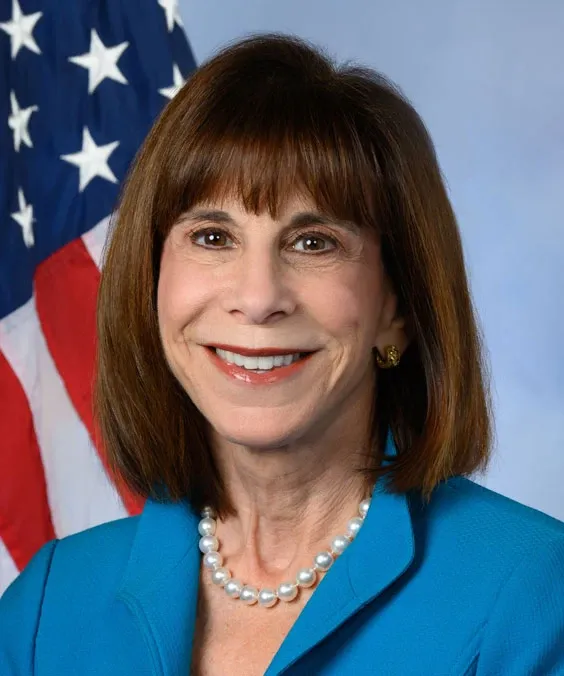
Deborah Koff Ross
The Public Record
Deborah Koff Ross is an American politician serving as the U.S. Representative for North Carolina's 2nd congressional district since 2015. A member of the Democratic Party, she has focused on issues such as healthcare, education, and economic development during her time in office. Ross has been an advocate for women's rights and has worked to promote policies that support families and children. Before her election to Congress, she served in the North Carolina General Assembly, where she was known for her commitment to public service and community engagement.
Dec 11, 2013
Because the cost of compliance is one of the largest--in fact compliance officers are one of the fastest growing occupations in this country, thanks in large part to the regulatory environment that we have here.
Dec 11, 2013
But there must be something here that allows for some assurance that consumers can be guaranteed that the Federal Government is not going to impose new requirements that raise premiums.
Nov 20, 2013
Recently, I received an email from a woman in my district named Shannon. Shannon received a letter from her health care provider stating that her current health care policy did not meet the requirements of the Affordable Care Act and that…
Nov 20, 2013
On rollcall Nos. 594 & 595 I was unavoidably detained. Had I been present, I would have voted, ``no.'' Amendment No. 4 Offered by Texas (Ms. Jackson Lee) The Acting CHAIR. The unfinished business is the demand for a recorded vote on the…
Nov 18, 2013
I think what we are trying to do is to provide not only some education as to how to mitigate against these flood zones, but also to encourage a private market to come into play so that they pool some of their risk and take it away from you.
Nov 18, 2013
Florida has a unique relationship with the National Flood Insurance Program.
Nov 18, 2013
While some might feel the government should wipe its hands of the problem, I would like to note that Congress created this problem.
Nov 18, 2013
The NFIP is over $24 billion in debt. The business model was flawed, and the program faced elimination.
Nov 18, 2013
Unfortunately, the implementation of the Biggert-Waters program has proven problematic.
Nov 12, 2013
As I mentioned in my opening statement, I very much believe in market-based solutions for risk problems.
Oct 28, 2013
The intent, of course, was to make sure that we had affordable housing, that low- to moderate-income people could have access to the American dream of homeownership.
Oct 28, 2013
Of course, my friends on the other side say this is not a bailout. It is just policy and it is an accounting function.
Sep 30, 2013
You know, I never supported ObamaCare because it's not sound policy. But if my fellow Americans have to endure this law, then why should not the Congress, the President, and the Vice President endure it as well? You see, today's vote is…
Sep 28, 2013
You know the only thing worse right now than having the implementation of this health care law known as ObamaCare on October 1 would be the implementation of this law with special consideration to Members of Congress. And some may say…
Sep 18, 2013
If we are going to say that we want a private market backed, then we need to allow them to have what traditionally private markets have in providing insurance.
Sep 18, 2013
I still believe that in this particular situation, a TRIA bill is necessary.
Sep 18, 2013
But the pricing is what concerns me, because right now, we have a government backstop and my history in government backstops, as you look at the National Flood Insurance Program, and as you look at citizens' property and causality…
Sep 11, 2013
But you would also agree though that there is a market out there for payday loans that is not being met by traditional bank or lending institutions.
Sep 11, 2013
Most likely, it will go offshore. Most likely, it will go on the Internet. You are not going to eliminate the demand just because you eliminate the supply.
Jul 16, 2013
I firmly believe that our sovereign debt should not go unpaid, but there is a tremendous difference between borrowing money to pay for an IRS 'Star Trek' video and paying our sovereign debt.
Jul 16, 2013
I think it is important that we acknowledge that having a healthy debate on the debt ceiling is prudent and responsible.
Jul 16, 2013
So my question to you, I guess, as a result is, if we impose the bank-centric capital requirements on insurance companies, would that have done anything to have saved AIG from its financial collapse of 5 years ago?
Jul 16, 2013
Would it be safe to say, in my last 20 seconds, that the future is not too bright for the nonbank financial institutions in terms of having any reduction in their capital requirements?
Politicians like Deborah Koff Ross