Great credit therefore was due and was cordially given to the large element in that party which was ready to brave all the opprobrium of their fellow-partisans and to accept the full responsibility of co- operating with the Republicans in…
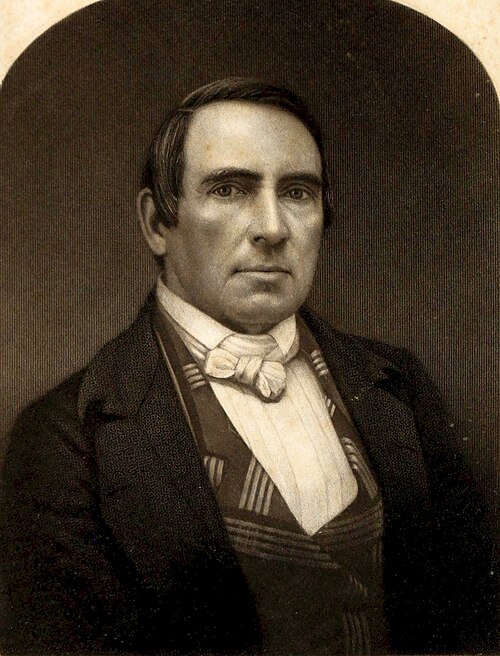
James Blaine
The Public Record
James Gillespie Blaine was an American statesman and Republican politician who represented Maine in the United States House of Representatives from 1863 to 1876, served as Speaker of the House from 1869 to 1875, and was a United States senator from 1876 to 1881. He served twice as Secretary of State, under presidents James A. Garfield and Chester A. Arthur in 1881, and under Benjamin Harrison from 1889 to 1892. He sought the Republican presidential nomination in 1876 and 1880, and received the nomination in 1884, narrowly losing the general election to Democratic nominee Grover Cleveland. Blaine was a prominent figure in the moderate faction of the Republican Party, known as the "Half-Breeds".
gutenberg.org
If the Democratic party as a whole had in the autumn of the year 1861 taken the ground which a considerable section of it assumed, it would have been impossible to conduct the war for the Union successfully.
It was apparent therefore within the first six months of the struggle that a division would come in the North, which would be of incalculable advantage to the insurrectionists, and that if the division should go far enough it would insure…
The great outburst of patriotism which followed the fall of Sumter contemplated a rally of the entire North for the defense of the Flag and the preservation of the Union.
Lincoln was quick to see that white laborers might be readily prejudiced by superficial reasoning, and hence he adduced the broader argument which appealed at once to their humanity, to their sense of manly independence, and to their…
The masses in the North had united with the Republican party in excluding Slavery from the Territories because the larger the area in which free labor was demanded the better and more certain was the remuneration.
Lincoln placed it, the free laborer in the North was disposed to regard a general emancipation of the slaves as tending to reduce his own wages, and as subjecting him to the disadvantage of an odious contest for precedence of race.
He pursued the wiser course of showing that the spirit of the Southern insurrection was hostile to all free labor, and that in its triumph not merely the independence of the laborer but his right of self-defense, as conferred by suffrage…
Let them beware of surrendering a political power which they already possess, and which, if surrendered, will surely be used to close the door of advancement, and to fix new disabilities and burdens upon them till all of liberty shall be…
In his message he avoided all direct expression upon the Slavery question, but with the peculiar shrewdness which characterized his political discussion he announced a series of general truths respecting labor and capital which, in effect…
Lincoln was conservative, and always desired to keep somewhat in the rear rather than too far in advance of the public judgment.
Not only therefore did the Confederacy introduce slaves as a component element of the military force, but it resorted to confiscation of a cruel and rigorous type as one of the sources of financial strength.
It was his sense of personal fidelity to the Southern men who had been faithful to him, that blinded him to the higher obligation of fidelity to country, and to the higher appreciation of self-interest which is inseparably bound up with…
His support did not come solely from those who had sympathized with the South, but included thousands who had been loyally devoted to the Union.
Breckinridge, the traitor, be and is hereby expelled from the Senate.
The Government learned that it is lawful to strike at whatever gives strength to the enemy, and that an insurgent against the National authority must, by the law of common sense, be treated as beyond the protection of the National…
The nation had learned that war must be conducted according to strict principles of military science, and cannot be successfully carried on with banners and toasts and stump speeches, or by the mere ardor of patriotism, or by boundless…
The virtue of this law consisted mainly in the fact that it exhibited a willingness on the part of Congress to strike very hard blows and to trample the institution of slavery under foot whenever or wherever it should be deemed…
As soon as this fact became well established, Congress proceeded to enact the first law since the organization of the Federal Government by which a slave could acquire his freedom.
To permit this was simply adding four millions to the population from which the Confederates could draw their quotas of men for military service.
In other words, it was made apparent that the slaves if undisturbed were to be a source of strength to the Rebellion.
It was soon discovered, however, that if the National Government did not interfere with slavery, slavery would seriously interfere with the National Government.
Indeed, the wisest of them saw that a premature declaration would probably prove a hinderance and not a help to the conclusion they most desired.
Many wise and far-seeing men were convinced from the first that the Rebellion would result in the destruction of slavery, but for various reasons deemed it inexpedient to make a premature declaration of their belief.
The public mind had been absorbed with the one thought of restoring the Union promptly and completely, and had not even contemplated interference with slavery as an instrumentality to that end.
Politicians like James Blaine