The Liberian experiment, honorable as it was to the colored race, and successful as it had proved in establishing civilization in Africa, had not attained such material prosperity as would justify the United States in the removal of…
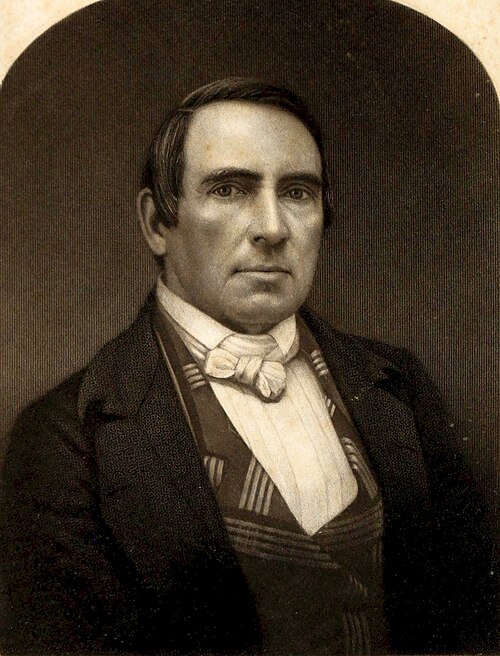
James Blaine
The Public Record
James Gillespie Blaine was an American statesman and Republican politician who represented Maine in the United States House of Representatives from 1863 to 1876, served as Speaker of the House from 1869 to 1875, and was a United States senator from 1876 to 1881. He served twice as Secretary of State, under presidents James A. Garfield and Chester A. Arthur in 1881, and under Benjamin Harrison from 1889 to 1892. He sought the Republican presidential nomination in 1876 and 1880, and received the nomination in 1884, narrowly losing the general election to Democratic nominee Grover Cleveland. Blaine was a prominent figure in the moderate faction of the Republican Party, known as the "Half-Breeds".
gutenberg.org
Colonization would deprive us of this much needed labor, would entail vast expense in the deportation of the negroes, and would devolve upon this country, by a moral responsibility which it could not avoid, the protection and maintenance…
The Colonization scheme deliberately proposed to strip the United States of patient, faithful laborers, acclimated to the cotton and sugar fields of the South, and capable of adding great wealth to the nation.
If free choice between the two conditions had been offered, nine-tenths, perhaps even a larger proportion of the slaves, would have preferred to remain in their old homes.
Colonization could be effected only by the forcible removal of the colored people, and this would have been a more cruel violation of their natural rights than a continuance of the slavery in which they were born.
The passage of the bill necessarily rendered futile every attempt at reconciliation.
What God and Nature decree, Rebellion cannot arrest." Mr.
In the presence of arms the Fugitive-slave Law became null and void, and the Dred Scott decision was trampled under the iron hoof of war.
But General Butler's judgment is justified by the rules of modern warfare, and its application solved a question of policy which otherwise might have been fraught with serious difficulty.
The anomaly of this situation was seen by General Butler, and he met it promptly by refusing to permit the slaves to be returned, declaring them to be contraband of war.
The winter preceding the outbreak of the rebellion had been so assiduously devoted by Congress to efforts of compromise and conciliation, that it was difficult to turn the public mind promptly to the other side, and to induce the people to…
The seeds of distrust had been sown and a bountiful crop of disaster was the natural growth.
The weakness of that great military movement was the lack of cordiality and confidence between the commander and the Administration at Washington.
The country will not fail to note (is now noting) that the present hesitation to move upon the intrenched enemy is but the story of Manassas repeated.
You will do me the justice to remember that I always insisted that going down the bay in search of a field, instead of fighting at or near Manassas, was only shifting and not surmounting the difficulty; that we would find the same enemy…
One great event of the battle was the death of Albert Sidney Johnston, a soldier of marked skill, a man of the highest personal character.
The navy had conquered its own place in the public regard, and had performed an inestimable service in the contest against the rebellion.
Perhaps no navy in the world had at that time abler officers than ours, while the rank and emolument, except for the lowest grades, was shamefully inadequate.
The academy had borne fruit, and at the outbreak of the war, the navy was filled with young officers carefully trained in the duties of their profession, intelligent in affairs, and with an esprit de corps not surpassed in the service of…
It was no longer regarded as a mere blockading force, but was menacing the coast of the Confederate States, penetrating their rivers, and neutralizing the strength of thousands of Rebel soldiers who were withdrawn from armies in the field…
But now the people saw that the most important post thus far wrenched from the Confederacy had been taken by the navy, and that it was effectively sustaining and strengthening the army at all points.
The relief to the North by this victory was incalculable.
The most sedate communities become mercurial and impressible in time of deep excitement.
General Grant had become in a day the hero of the war.
The effect of the victory upon the country was electric.
Politicians like James Blaine