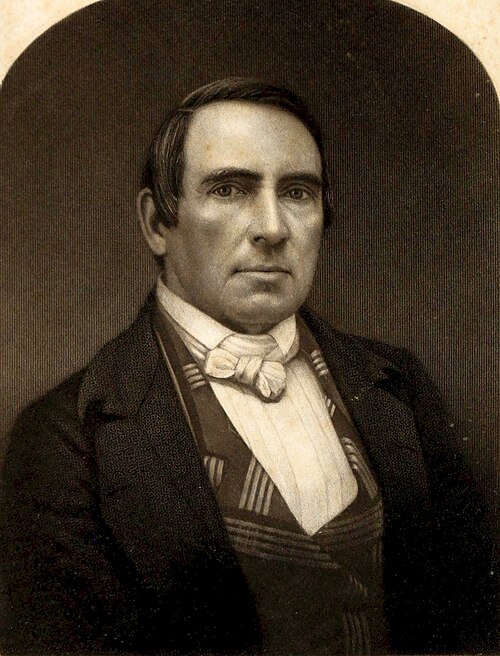
Without power as an orator, he was listened to in the Senate with profound attention, as one who never offered counsel that was not needed.
James Blaine
The Public Record
James Gillespie Blaine was an American statesman and Republican politician who represented Maine in the United States House of Representatives from 1863 to 1876, served as Speaker of the House from 1869 to 1875, and was a United States senator from 1876 to 1881. He served twice as Secretary of State, under presidents James A. Garfield and Chester A. Arthur in 1881, and under Benjamin Harrison from 1889 to 1892. He sought the Republican presidential nomination in 1876 and 1880, and received the nomination in 1884, narrowly losing the general election to Democratic nominee Grover Cleveland. Blaine was a prominent figure in the moderate faction of the Republican Party, known as the "Half-Breeds".
gutenberg.org
In the periods of excitement through which the party was about to pass, his judgment was sure to prove of highest value--influenced, as it always was, by patriotism, and guided by conscience.
He had a lofty disregard of personal danger, possessing both moral and physical courage in a high degree.
He was never swayed from his conclusion by the passion of the hour, and he met the gravest responsibilities with even mind.
The general character of his mind was conservative, and he had the heartiest contempt of every thing that savored of the demagogue in the conduct of public affairs.
He possessed that peculiar strength with the people--the most valuable and most enduring a public man can have--which comes from a sense of pride in the ability and character of the representative.
He was brilliant from his youth upward; had led the Maine Legislature when but a few years beyond his majority; and, at a time when members of the legal profession are struggling for a first foot-hold, he had stepped to the front rank in…
The Senate, though deprived by secession of many able men from the South, presented an imposing array of talent, statesmanship, and character.
The situation was startling and serious, and for the first time people began to realize that we were to have a war with bloody fighting and much suffering, with limitless destruction of property, with costly sacrifice of life.
The very shock of arms in the harbor of Charleston, it was believed by many, might upon sober second thought induce Southern men to pause and consider and negotiate before taking the fatal plunge.
If their work cannot be traced in the National statute-books as prominently as that of their opponents, they will be credited by the discriminating reader of our political annals as the English of to-day credit Charles James Fox and his…
In their training, in their habits of mind, in their pride and independence, in their lack of discipline and submission, they were perhaps specially fitted for opposition, and not so well adapted as men of less power, to the responsibility…
In the South, though always resting under the imputation of not being so devoted to the support of Slavery as their opponents, they yet maintained themselves, by the power of intellect and by the prestige of chivalric leadership, in some…
No party in the United States ever presented a more brilliant array of talent than the Whigs.
In the day of their strength the Whigs could not have been overborne in the South by the Secessionists, nor would the experiment have been tried.
By reckless daring a minority of Southern men raised a storm of sectional passion to which the friends of the Union bowed their heads and surrendered.
In such a contest conservatism always goes down, and radicalism always triumphs.
In a secret ballot, where every man could have voted according to his own convictions and desires, the Secession scheme would have been defeated in Virginia, North Carolina, Georgia, Tennessee, and Arkansas.
The precipitate manner in which the Southern men of the ancient Whig faith yielded their position as friends of the Union was an instructive illustration of the power which a compact and desperate minority can wield in a popular struggle.
But they are responsible for permitting a party whose rank and file did not outnumber their own to lead captive the public opinion of the South, and for permitting themselves to be pressed into a disavowal of their political principles…
A large share of the responsibility for the dangerous development of the Rebellion must therefore be attributed to John Bell and his half million Southern supporters, who were all of the old Whig party.
The Bell and Everett campaign had been conducted upon the single and simple platform of the Union and the Constitution,--devotion to the Union, obedience to the Constitution.
The vote which Governor Stanford received in September, 1861, shows how rapid, radical, and complete was the political revolution caused in California by the Southern Rebellion.
The enthusiastic devotion which these distant States showed to the Union was therefore a surprise to the South and a most welcome relief to the National Government.
But in the art of presenting with force and clearness a subject which he had studied, of analyzing it and simplifying it to the comprehension of the common mind, of clothing it in language as plain and forcible as the diction of John…
Politicians like James Blaine