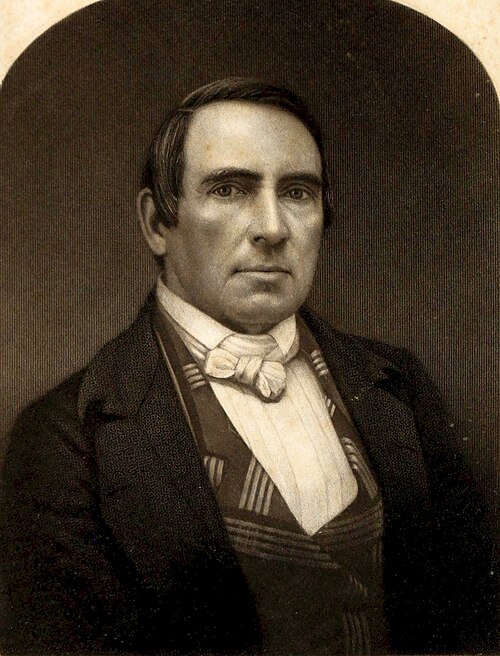
He possessed a mind of extraordinary strength; and in frequent contests at the bar and upon the stump, he had thoroughly disciplined his faculties.
James Blaine
The Public Record
James Gillespie Blaine was an American statesman and Republican politician who represented Maine in the United States House of Representatives from 1863 to 1876, served as Speaker of the House from 1869 to 1875, and was a United States senator from 1876 to 1881. He served twice as Secretary of State, under presidents James A. Garfield and Chester A. Arthur in 1881, and under Benjamin Harrison from 1889 to 1892. He sought the Republican presidential nomination in 1876 and 1880, and received the nomination in 1884, narrowly losing the general election to Democratic nominee Grover Cleveland. Blaine was a prominent figure in the moderate faction of the Republican Party, known as the "Half-Breeds".
gutenberg.org
His influence in aid of the finances of the government in its early period of depression was given without stint and was of incalculable value.
New York and Pennsylvania of themselves constituted no mean power, with a population of seven millions, with their boundless wealth, and their ability to produce the material of war.
Throughout the six States there was but one anxiety, one resolve,--anxiety for the safety of the government, resolve to subdue the revolt against it.
The vigor which Massachusetts had imparted to the Revolution against the Crown was surpassed by the ardor with which she now threw herself into the contest for the Union.
They were not only eminent in an intellectual point of view, but they had a special fitness for the arduous and patriotic duties so unexpectedly devolved upon them.
Lincoln was disappointed at this proof of the sectional character of the contest, and he realized that if American nationality was to be preserved, it must look for help to the abounding resources and the patriotic loyalty of the free…
It is fair that his action should be clearly understood, and that his name should bear the just responsibility.
He believed in the Union of the States, and he stood by his country with a fervor and energy of patriotism which enshrined his name in the history and in the hearts of the American people.
Perhaps no words spoken carried confidence to more hearts, or gave greater strength to the National cause.
His address on that memorable occasion was worthy of the loftiest patriot, and was of inestimable value to the cause of the Union.
The value of his active loyalty to the Union may be measured by the disaster which would have been caused by hesitation on his part.
Douglas had spoken no partisan word, had known no partisan division, had labored only for the government of the nation, had looked only to its safety and its honor.
Yesterday there had been division; to-day there was unity.
Yesterday there had been doubt and despondency; to- day had come assurance and confidence.
Never was popular delusion so suddenly and so completely dispelled.
At home it would discourage the friends of the Union, embolden its adversaries, and go far to insure to the latter a recognition abroad.
He wisely saw that if he failed to do this he would be receding from the temperate and conservative position taken in the Inaugural, and that it would give to the Confederates a degree of courage, and to the North a degree of despondency…
Though many patriotic men of conservative or timid nature advised a quiet withdrawal from Fort Sumter rather than an open conflict for its possession, there was an instinctive undertone in the masses of the people in the Northern States…
Lincoln's administration may have wavered in regard to the expediency of re-enforcing Major Anderson and holding possession of Fort Sumter, but the President himself wisely concluded that to retreat from that point would be an almost fatal…
The point had been reached where it was necessary to go forward or go backward; where the Confederacy must assert itself, or the experiment of secession be abandoned.
If, after all efforts at peace, war should be found unavoidable, the Administration had determined so to shape its policy, so to conduct its affairs, that when the shock came it should leave the South entirely in the wrong, and the…
Lincoln saw, moreover, that war between a divided North and a united South would be a remediless calamity.
He feared that the Southern mind was in the condition in which a single untoward circumstance might precipitate a conflict, and he determined that the blood of his brethren should not be on his hands.
He believed that with the continuance of peace, the Secessionists could be brought to see that Union was better than war for all interests, and that in an especial degree the institution of Slavery would be imperiled by a resort to arms.
Politicians like James Blaine