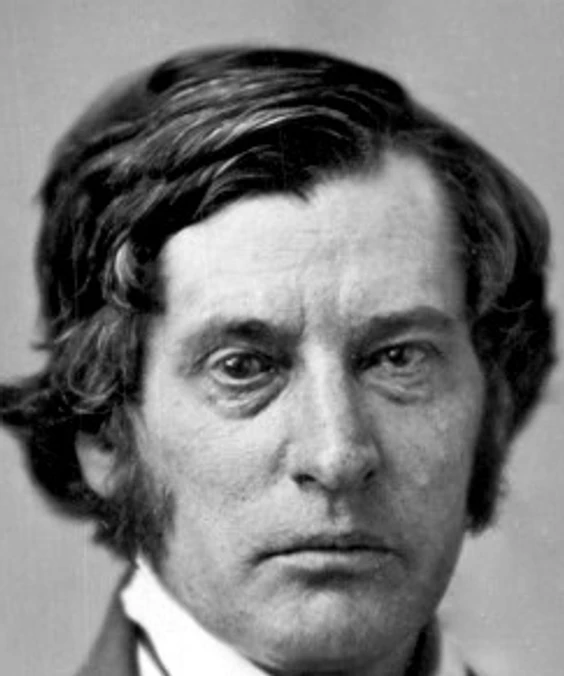
It is only on fitting occasions, when great principles are to be vindicated, and solemn truths told, when some moral or political Waterloo or Solferino is to be fought, that he puts on the entire panoply of his gorgeous rhetoric.
George F. Hoar
The Public Record
gutenberg.org
I had just time to hear this sentence, and shut the door and hurry to my train: "She went down the harbor, painted and perfidious--a coffin, but no ship.
Whether you liked him or disliked him, you gave him your ears, erect and intent.
The phraseology with which he clothed some commonplace or mean thought or fact, when he was compelled to use commonplace arguments, or to tell some common story, kept his auditors ever alert and expectant.
He showed that his client, or witness, or proposition, belonged to a class of itself.
When he was confronted with some general rule, or some plain fact, he had a marvellous art of subtle distinction.
He never appealed to base motives, nor tried to awake coarse prejudices or stormy passions.
But with inferior magistrates and juries, however intelligent, however determined they were in a made-up opinion, however on their guard against the charmer, he was almost irresistible.
He is the only advocate I ever heard who had the imperial power which would subdue an unwilling and hostile jury.
The beauty of this dialect is that while it is capable alike of such tenderness, and such lofty eloquence, and such exquisite and delicate humor, it is, like our Saxon, incapable of falsetto, or of little pomposities.
But it is a better (bitter) thing to hate ye.
He once began a prayer, "O Lord, it is a braw thing to loe ye.
It came straight from his heart, and he kindled in the bosoms of his listeners the ardor of his own heart.
Still it was a lofty morality and a lofty ideal statesmanship.
He had, in a large measure, a failing which all Englishmen have, and always had; the notion that what is good for England is good for humanity at large.
What he had to say would have been true and apt and fit to be uttered in the earlier days of Athens and Rome, and true and apt and fit to be uttered for thousands of years to come.
The discussion became alike one of the highest moral principles and the profoundest political philosophy.
When he entered upon a discussion in Parliament, or on the hustings, he elevated it to the highest possible plane.
Gladstone was the last of a school of oratory, and the last of our time--I hope not for all time--of a school of statesmen.
It is an old-fashioned political expedient; it is not adapted to the circumstances which we have to encounter in the present, and because it has no real foundation of truth or policy, it will meet with defeat and discomfiture.
He makes the impression on his hearers, an impression made, but not so strongly, upon his readers, that the matter he is discussing is that upon which the foundations of heaven and earth rest.
The great quality of Gladstone, as of Sumner, is his profound seriousness.
We do not believe that the disposition to bribe can operate with anything like its present force when the means of tracing the action of the man bribed are taken away, because men will not pay for that they do not know they will ever…
We propose, by secret voting, to greatly diminish the first of these, and we hope to take away the second.
That by marking his vote you expose the voter to be tempted through his cupidity and through his fears.
Politicians like George F. Hoar