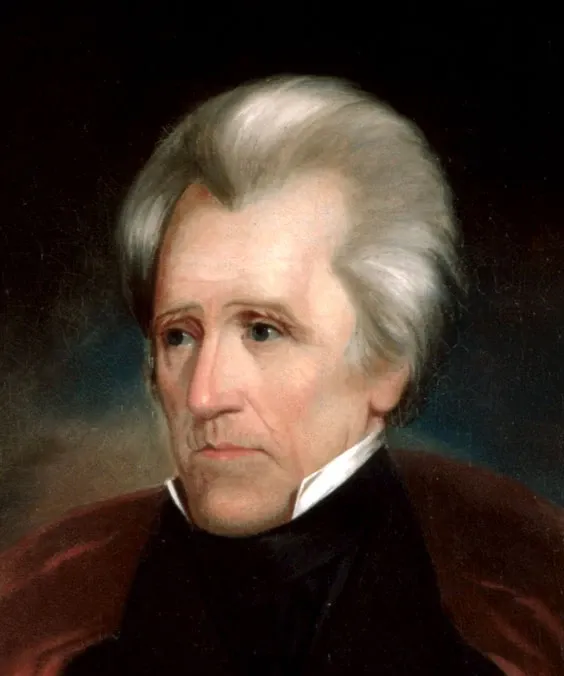
There is no military or other necessity, real or pretended, which can prevent obedience to the Constitution, either North or South.
Andrew Johnson
The Public Record
Andrew Johnson was the 17th President of the United States, serving from April 15, 1865, to March 4, 1869. A member of the Democratic Party, he was born in Tennessee and became the first president to assume office following the assassination of Abraham Lincoln. Johnson's presidency was characterized by his strong opposition to the Reconstruction policies implemented by Congress, which aimed to rebuild the South and secure rights for newly freed African Americans. His resistance to these policies ultimately led to his impeachment by the House of Representatives in 1868, although he was acquitted by the Senate and remained in office until the end of his term.
gutenberg.org
All the rights and all the obligations of States and individuals can be protected and enforced by means perfectly consistent with the fundamental law.
Crimes against the United States can be prevented or punished by the proper judicial authorities in a manner entirely practicable and legal.
There is therefore no reason why the Constitution should not be obeyed, unless those who exercise its powers have determined that it shall be disregarded and violated.
The mere naked will of this Government, or of some one or more of its branches, is the only obstacle that can exist to a perfect union of all the States.
The hope that we may all finally concur in a mode of settlement consistent at once with our true interests and with our sworn duties to the Constitution is too natural and too just to be easily relinquished.
If we admit now that they were valid and effectual for the purpose intended by their authors, we sweep from under our feet the whole ground upon which we justified the war.
It can not be that a successful war, waged for the preservation of the Union, had the legal effect of dissolving it.
The victory of the nation's arms was not the disgrace of her policy; the defeat of secession on the battlefield was not the triumph of its lawless principle.
To dissolve the Union is to repeal the Constitution which holds it together, and that is a power which does not belong to any department of this Government, or to all of them united.
The Executive (my predecessor as well as myself) and the heads of all the Departments have uniformly acted upon the principle that the Union is not only undissolved, but indissoluble.
If they were not States, or were States out of the Union, their consent to a change in the fundamental law of the Union would have been nugatory, and Congress in asking it committed a political absurdity.
If the Southern States are component parts of the Union, the Constitution is the supreme law for them, as it is for all the other States.
The right of the Federal Government, which is clear and unquestionable, to enforce the Constitution upon them implies the correlative obligation on our part to observe its limitations and execute its guaranties.
Without the Constitution we are nothing; by, through, and under the Constitution we are what it makes us.
We may doubt the wisdom of the law, we may not approve of its provisions, but we can not violate it merely because it seems to confine our powers within limits narrower than we could wish.
It is not a question of individual or class or sectional interest, much less of party predominance, but of duty--of high and sacred duty--which we are all sworn to perform.
To express gratitude to God in the name of the people for the preservation of the United States is my first duty in addressing you.
It is to state with frankness the principles which guide my conduct, and their application to the present state of affairs, well aware that the efficiency of my labors will in a great measure depend on your and their undivided approbation.
The Union of the United States of America was intended by its authors to last as long as the States themselves shall last.
To form a more perfect Union," by an ordinance of the people of the United States, is the declared purpose of the Constitution.
The hand of Divine Providence was never more plainly visible in the affairs of men than in the framing and the adopting of that instrument.
It is beyond comparison the greatest event in American history, and, indeed, is it not of all events in modern times the most pregnant with consequences for every people of the earth?
The members of the Convention which prepared it brought to their work the experience of the Confederation, of their several States, and of other republican governments, old and new; but they needed and they obtained a wisdom superior to…
And when for its validity it required the approval of a people that occupied a large part of a continent and acted separately in many distinct conventions, what is more wonderful than that, after earnest contention and long discussion, all…
Politicians like Andrew Johnson