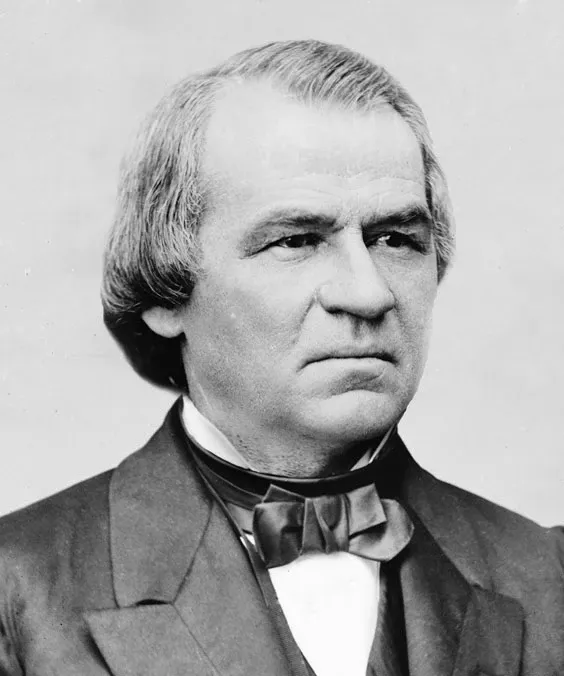
We have but to look at the state of our agriculture, manufactures, and commerce and the unexampled increase of our population to feel the magnitude of the trust committed to us.
Andrew Jackson
The Public Record
Andrew Jackson was the seventh President of the United States, serving from 1829 to 1837. A member of the Democratic Party, he is known for his populist style of politics and for being a founding figure of the party. Jackson's presidency was marked by significant events such as the Indian Removal Act and the Nullification Crisis, which highlighted his strong stance on federal authority. Before his presidency, he served as a military governor of Florida and held positions in both the U.S. House of Representatives and the Senate.
gutenberg.org
Let us trust that this admonition will never be forgotten by the Government or the people of the United States, and that the testimony which our experience thus far holds out to the great human family of the practicability and the…
The social elements, which were strong and successful when united against external danger, failed in the more difficult task of properly adjusting their own internal organization, and thus gave way the great principle of self-government.
In the example of other systems founded on the will of the people we trace to internal dissension the influences which have so often blasted the hopes of the friends of freedom.
The attempt will meet with resistance where it might otherwise receive support, and instead of strengthening the bonds of our Confederacy it will only multiply and aggravate the causes of disunion.
I am not hostile to internal improvements, and wish to see them extended to every part of the country.
I therefore embraced that early occasion to apprise Congress that in my opinion the Constitution did not confer upon it the power to authorize the construction of ordinary roads and canals within the limits of a State and to say…
The powers exercised by the Federal Government would soon be regarded with jealousy by the State authorities, and originating as they must from implication or assumption, it would be impossible to affix to them certain and safe limits.
That the most injurious conflicts would unavoidably arise between the respective jurisdictions of the State and Federal Governments in the absence of a constitutional provision marking out their respective boundaries can not be doubted.
To suppose that because our Government has been instituted for the benefit of the people it must therefore have the power to do what ever may seem to conduce to the public good is an error into which even honest minds are too apt to fall.
But against the dangers of unconstitutional acts which, instead of menacing the vengeance of offended authority, proffer local advantages and bring in their train the patronage of the Government, we are, I fear, not so safe.
The sentence of condemnation long since pronounced by the American people upon acts of that character will, I doubt not, continue to prove as salutary in its effects as it is irreversible in its nature.
There can be no question connected with the administration of public affairs more important or more difficult to be satisfactorily dealt with than that which relates to the rightful authority and proper action of the Federal Government…
Could this be attained, and the terms of those officers be limited to a single period of either four or six years, I think our liberties would possess an additional safeguard.
All the reflection I have been able to bestow upon the subject increases my conviction that the best interests of the country will be promoted by the adoption of some plan which will secure in all contingencies that important right of…
It is undoubtedly the duty of Congress to place all the States on the same footing in this respect, either by the creation of an additional number of associate judges or by an enlargement of the circuits assigned to those already appointed…
Nothing can be more desirable than the uniform operation of the Federal judiciary throughout the several States, all of which, standing on the same footing as members of the Union, have equal rights to the advantages and benefits resulting…
The principle is as sound in relation to this as to any other Department of the Government, that as little discretion should be confided to the executive officer who controls it as is compatible with its efficiency.
To a measure so important to the Government and so just to our constituents, who ask no exclusive privileges for themselves and are not willing to concede them to others, I earnestly recommend the serious attention of Congress.
The wide seas which separate us from other Governments must of necessity be the theater on which an enemy will aim to assail us, and unless we are prepared to meet him on this element we can not be said to possess the power requisite to…
When we reflect upon our position in relation to other nations, it must be apparent that in the event of conflicts with them we must look chiefly to our Navy for the protection of our national rights.
A just economy, expending where the public service requires and withholding where it does not, is among the indispensable duties of the Government.
The honest veteran has nothing to fear from such a scrutiny, while the fraudulent claimant will be detected and the public Treasury relieved to an amount, I have reason to believe, far greater than has heretofore been suspected.
All will agree that the services and sufferings of the remnant of our Revolutionary band should be fully compensated; but while this is done, every proper precaution should be taken to prevent the admission of fabricated and fraudulent…
I am satisfied, however, it has been such as to justify a re-examination of the system and the adoption of the necessary checks in its administration.
Politicians like Andrew Jackson