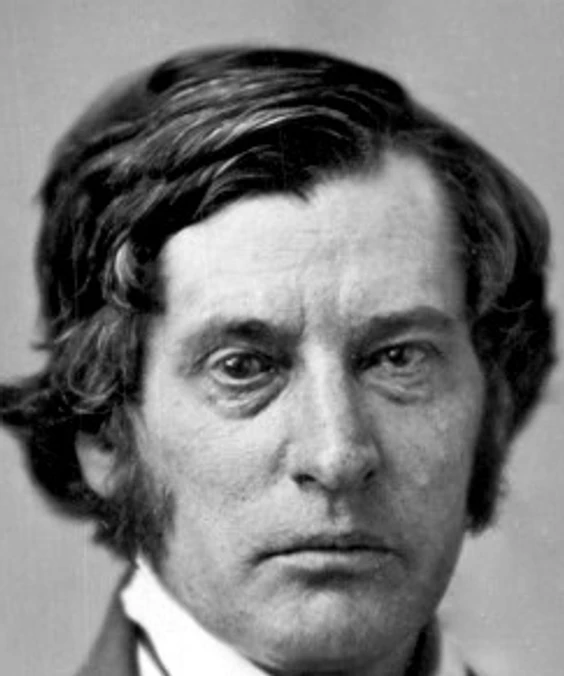
I have always lamented, in common with all the friends and lovers of both these great men, that they should have so misunderstood each other; yet it was not unnatural.
George F. Hoar
The Public Record
gutenberg.org
Now if Sheridan, as most men would have done, had waited for orders from me, Lee would have got off." I listened with wonder at the generous modesty which, before that brilliant company, could remove one of the brightest laurels from his…
One of the virtues of General Sheridan was that he knew when to act without orders.
He knew there was some very uncomfortable thing which stood in his way of promptly suppressing the crimes in Louisiana, where he said more men had been murdered for their political opinions than were slain in the Mexican War.
He said that speculators and bankers and brokers could foresee the changes which came about from the fluctuations of paper money and protect themselves from them, but the workingmen and poor men had no such advantages--that they were the…
He said that it was an immense injury to all classes of the people, but that it bore heavily upon poor and ignorant men.
He then went on to express very earnestly his objection to the measure and to the whole policy, and his dislike of irredeemable paper.
This veto is regarded by most persons as the turning of the corner by the American people, and setting the face of the Government toward specie payment and honest money.
One of the most important acts of President Grant's Administration was his veto of the Inflation Bill, which provided for a considerable increase of the large volume of legal tender paper money, which at that time was not redeemed by the…
I thought it much less likely to be imputed to him that he was acting in the manner of a soldier and not of a statesman if he were careful to ask in advance the direction of the law-making power, and the people understood he was unwilling…
I asked him if he did not think it would be better, instead of exercising a doubtful authority of his own, acquired without legislative sanction, to obtain the necessary authority from Congress in advance.
He would be compelled, in my judgment, to interpose and go to the verge of his authority, or to leave to their fate those people whom we were bound by every consideration of honor to protect.
Won't you say something?" I then made a little speech to the President, in which I said that there was no question of the existence of these disorders and crimes; that they would be likely to be increased, and not diminished, especially as…
President Grant said that he had been asked to send in a message urging Congress to pass a law giving him larger powers for the suppression of violence at the South; but he had sent for us to explain the reason why he was unwilling to do…
I told him of General Washington's interest in a national university, and what he had said about the importance of education in his writings.
I called on the President when the last State needed had ratified the Fifteenth Amendment, and suggested to him that it might be well to send a special message to Congress congratulating them on the result, and urging the policy of…
I saw him write two messages to Congress, both of a good deal of importance, without pause or correction, and as rapidly as his pen could fly over the paper.
There has never been, within my experience, a greater power than his on the floor of the House.
Dawes's amendment was adopted, the bill passed, the New England industries saved, and the tariff reformers beaten.
He studied and worked out for himself very abstruse questions, on which he formed his own opinions, usually with great sagacity.
In addition to the striking qualities which caught the public eye, he was a man of profound knowledge of our political history, of a sure literary taste, and of great capacity as an orator.
There has probably never been a man in our history upon whom so few people looked with indifference.
On the other hand their antagonist has been, is, and for an indefinite time to come will be, controlled by the foreign population and the criminal classes of our great cities, by Tammany Hall, and by the leaders of the solid South.
The Republican Party, whatever its faults, since it came into power in 1860 has been composed in general of what is best in our national life.
Every man must settle for himself the question of his individual duty.
Politicians like George F. Hoar