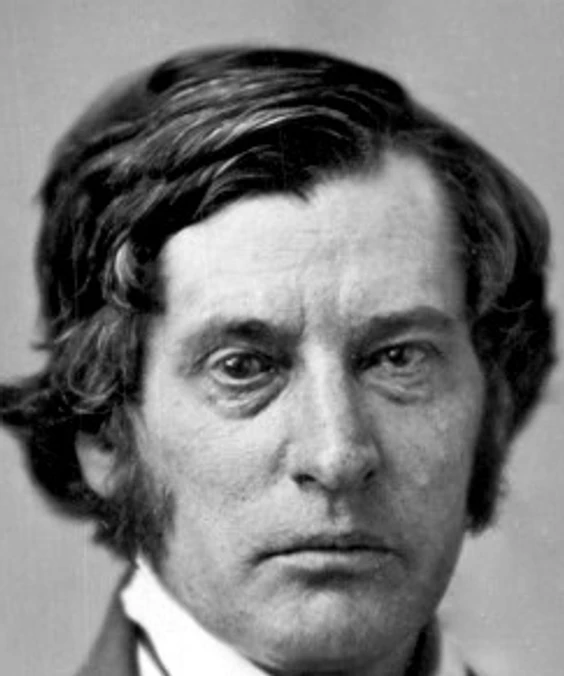
When his District Convention met and passed resolutions in favor of paying interest on the Government bonds with paper, Garfield declared that he would not take the nomination on such a platform.
George F. Hoar
The Public Record
gutenberg.org
He stood like a rock when Ohio and the whole West seemed to be going against him, and when the statesmanship even of John Sherman was of the willow and not of the oak.
But he studied the financial question, especially the great subjects of currency and the standard of value, to the very bottom.
He hesitated long as to the doctrine of protection, and undoubtedly made some inconsistent utterances before he took the ground which he held at last.
But when he had had time and had thought the thing out and made up his mind, nobody and no consideration of personal interest or advantage would stir him an inch.
When, after he had expressed his opinion, some strong and positive man came to him with a confident utterance of a different opinion, unless Garfield had gone to the bottom of the subject himself, he was very likely to defer, to hesitate…
Garfield, when I can say some things which ought to be said, and for which there is not room in this book and was not room in the eulogy delivered just after his death.
Lincoln, under the circumstances, could not have got the support of his own State, and without it it seemed unwise to attempt a union upon him.
But the precedent of permitting such a body to be addressed under any circumstances by a person not a member would be a dangerous one, if repeated.
I do not believe it ever happened before that anybody who attempted to decline the Presidency of the United States was to be prevented by a point of order, or that such a thing will ever happen again.
No man has a right, without the consent of the person voted for, to announce that person's name, and vote for him, in this convention.
We were in thorough accord in our love for New England, our firm faith in her hereditary principles, and our pride in her noble history.
I said on the first day of the convention that in my opinion if the delegates could be shut up by themselves and not permitted to leave the room until they agreed, the man on whom they would agree would be General Garfield.
Not in Chicago, in the heat of June, but at the ballot-boxes of the Republic, in the quiet of November, after the silence of deliberate judgment, will this question be settled.
When your enthusiasm has passed, when the emotions of the hour have subsided, we shall find below this storm and passion that calm level of public opinion from which the thoughts of a mighty people are to be measured, and by which their…
When the storm has passed and the hour of calm settles on the ocean, when the sunlight bathes its peaceful surface, then the astronomer and surveyor take the level from which they measure all terrestrial heights and depths.
I have seen the sea lashed into fury and tossed into spray, and its grandeur moves the soul of the dullest man; but I remember that it is not the billows, but the calm level of the sea from which all heights and depths are measured.
Nothing touches my heart more quickly than a tribute of honor to a great and noble character.
I can only compare it in its grandeur and impressiveness to the mighty torrent of Niagara.
The fate of the country, certainly the fate of a great political party, was at stake, and, more than that, the selection of the ruler of a nation of fifty millions of people--a question which in other countries could not have been…
One of the greatest oratoric triumphs I ever witnessed was obtained by Garfield.
I do not think I am fit for it, and if I were, I should much prefer my present service as Senator.
If I know myself, I have no desire to be President of the United States.
Any measure of which he was the author would be likely to accomplish its purpose, and to stand fire.
But he possessed what persons of that temper commonly lack, great capacity for constructive statesmanship.
Politicians like George F. Hoar