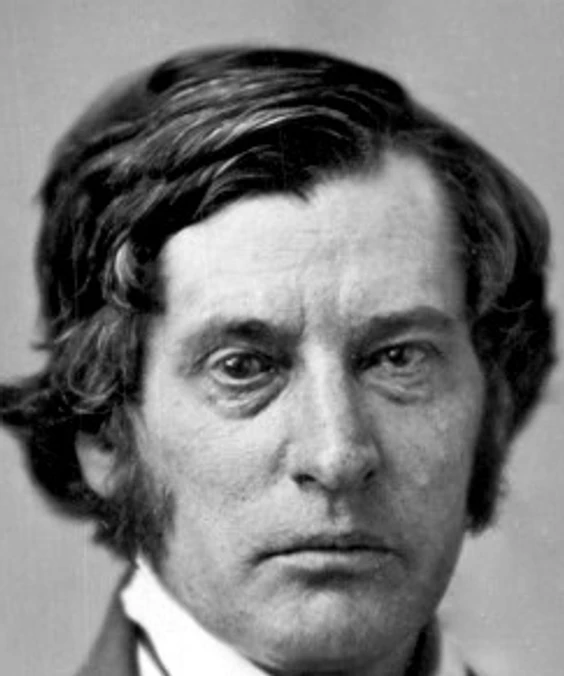
After saying what was to be said about the English Mission, I said to President Harrison: "We have a gentleman in Massachusetts, whom I think it is very desirable indeed to place in some important public service; that is Thomas Jefferson…
George F. Hoar
The Public Record
gutenberg.org
He did not see fit to make the exercise of the President's rightful and Constitutional prerogative a reason for breaking off his friendly relations with the Administration, with whose principles he was in full accord.
But he had seen the importance of the protective policy to American interests, as would naturally be expected of a descendant of that high protectionist, Thomas Jefferson.
I think he would have been Governor of the State and had a very brilliant career but for a delicacy of organization which made him break down in health when under any severe strain of responsibility, especially such as involved antagonism…
You sit in your deck-chair with the soft sea breeze on your forehead, as the mighty ocean cradle rocks you, and see the lace of an exquisite beauty that no Tyrian weaver ever devised, breaking over the blue or purple waves, with their…
It was as if I had had in my hand the crown jewels of every potentate in the world, and somebody had told me the history of each gem.
I shall never forget the delight of that day.
I had been a loving reader of Scott from my childhood, and was almost as much at home in Scotland as if I had been born in the Canongate or the Saltmarket.
Certainly there is nothing like England, and there never has been anything like England in the world.
He said he had little sympathy for the Unitarianism of his day, "for its theology, no; for its spirituality, yes.
Gibbon wrote of decline, of decay, of dissolution, and death; of the days, to use his own words, 'when giants were becoming pigmies.' Bancroft tells the story of birth, and growth, and youth, and life.
And so the grandeur of the forest tree Comes, not from casting in a formal mould, But from its own divine vitality.
Because the lovely little flower is free Down to its roots, and in that freedom bold.
This shows how perfectly state rights and state freedom are preserved in spite of our National union, how little the power at the centre interferes with the important things that affect the character of a people.
It is one of the most wonderful things in our history, that the separate States having so much in common, have preserved so completely, even to the present time, their original and individual characteristics.
Bancroft tells the story of thirteen States, separate, yet blending into one National life.
But his narrative never loses its constant and fascinating interest.
As an artist he has accomplished that most difficult task of composing a history made up of many separate threads, which must keep on side by side, yet all be subordinate to one main and predominant stream.
He has had the rare good fortune among men of letters, to have proposed to himself a great task, requiring a lifetime for its accomplishment, the successful achievement of which is enough to make any life illustrious, and to have lived to…
I believe his work will endure so long as the love of liberty shall endure.
He believed that the great emotions and motives which move a free people are the noble, not the mean motives.
Bancroft had two enthusiasms which made him a great historian-- an enthusiasm for truth which spared no labor and left no stores of information unsearched, and an enthusiastic love of country.
The finished picture bears this inscription: 'What Titian left unfinished, Palma reverently completed, and dedicated to God.' So may our beloved Republic find always, when one servant leaves his work unfinished, another who will take it up…
He had a rare and exquisite gift which, if he had been a man of letters and not a man engaged in a strenuous public life, would have brought him great fame.
He was, in the things he stood for, as unyielding as flint and true as steel.
Politicians like George F. Hoar