By his proposition the Fugitive Slave Law was to be repealed, and in its place the respective States were to return fugitives or to pay the value of those that might be retained.
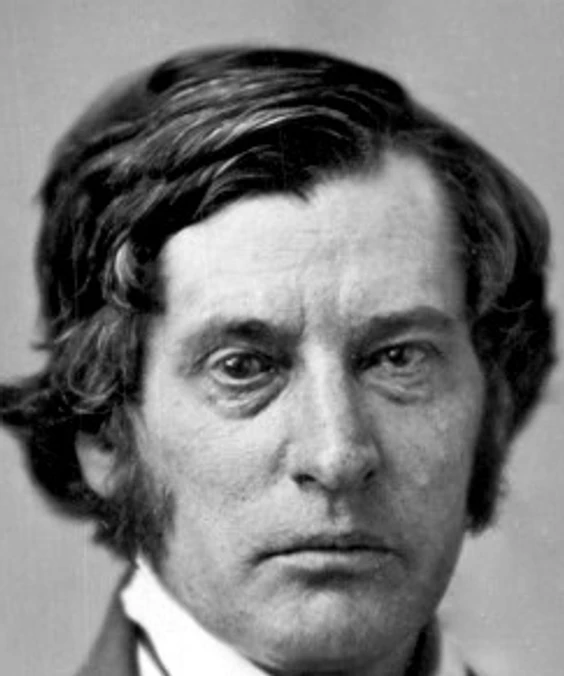
George Boutwell
The Public Record
United States politician (1818–1905)
gutenberg.org
Johnson never identified himself with the Republican Party; and neither in June, 1864, nor at any other period of his life, had the Republican Party a right to treat him as an associate member.
It ended in an appeal to the people, who rendered a judgment against the President by a two-thirds majority.
Indeed, he assumed, without reserve, full responsibility for acts that had been charged on the President by others.
The President hesitated, and then declined to renew the order, saying: "Stanton is generally right.
Of those who were nearest to him, no one ever received the impression from his acts or his conversation that he thought of the Presidency as a possibility under any circumstances.
He should live in history as a true patriot and a man of the highest integrity.
If we cannot say that Thomas was a great soldier in the large use of the phrase, it can be said that he was a good soldier and that without qualifying words.
As the loyal men of the South were greater sufferers from the war, their hostility was more intense against those who were responsible for the war.
They have not yet given up their desire for a separate government, and if they have an opportunity to strike for it again they will do so.
Moral obliquity is not to be assumed in the case of General Lee.
If in 1861 an officer of the army had entertained the opinion that the North was in the wrong and that the South was in the right, it could be claimed, fairly, that that officer might forswear his obligations to the old Government and…
He had always favored a free exchange of prisoners, knowing that the proper means for the care and comfort of prisoners could not be furnished in the Confederacy.
Indeed his doctrine of State Rights excused the citizen and placed the sole responsibility on the State.
Freedom from duplicity was a controlling feature in General Grant's character and in that attribute of greatness Grant and Lee may have been equals.
General Grant's testimony is explicit upon these points: He advised President Johnson to grant a pardon to General Lee and a pardon to General Johnston.
Hence General Grant's declarations that his part was limited to the military side of the measure and that in his view the entire plan was subject to Congressional action.
His training at West Point may have given him a knowledge of principles and his good sense enabled him to apply the principles in the terms that he dictated at Appomattox.
These quotations give General Grant's standing as an interpreter of public law and as a leader capable of applying the rules and principles of public law to practical affairs.
The parole gave them protection and exemption from punishment for all offences not in violation of the rules of civilized warfare.
I thought that that was a matter entirely with Congress, over which I had no control, that simply as general-in-chief commanding the army, I had a right to stipulate for the surrender on terms which protected their lives.
I told him when they violated their parole." In the opinion of General Grant the terms of the parole did not include Jefferson Davis, as he had been captured.
The nature of the questions led General Grant to make this remark: "I will state here, that I am not quite certain whether I am being tried, or who is being tried, by the questions asked.
When my State seceded I thought I must go too, and so I left Massachusetts and returned to South Carolina.
If Georgia is a State in the Union her people feel that she is entitled to representation without conditions imposed by Congress; and if she is not a State in the Union then she could not be admitted as an equal with the others if her…
Politicians like George Boutwell