May 5, 2011
May I inquire how much time remains on both sides. The Acting CHAIR (Mr. Bass of New Hampshire). The gentleman from Washington has 16\3/4\ minutes remaining, and the gentleman from Massachusetts has 16 minutes remaining.
The Public Record
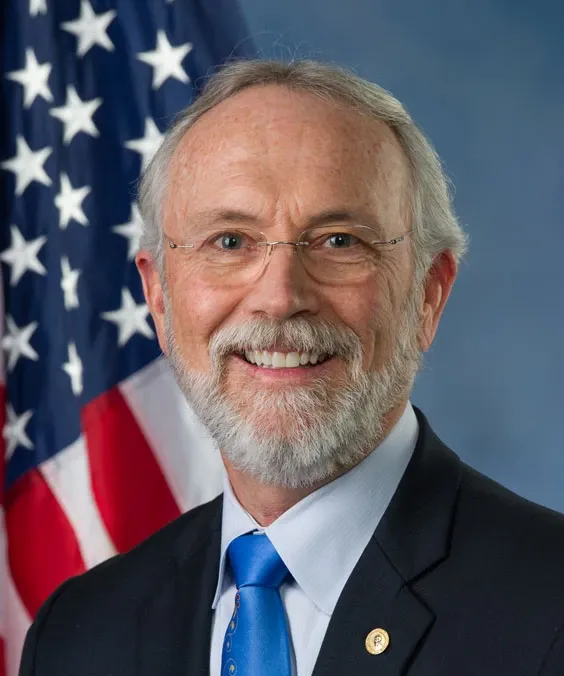
Doc Hastings is a former Republican member of the United States House of Representatives, representing Washington's 4th congressional district from 1995 to 2015. During his tenure, he served on several key committees, including the House Committee on Natural Resources, where he focused on issues related to energy and natural resource management. Hastings was known for his advocacy of agricultural interests and water resource management, reflecting the priorities of his largely rural district. He played a significant role in various legislative efforts, including those aimed at promoting economic development in Eastern Washington.
May I inquire how much time remains on both sides. The Acting CHAIR (Mr. Bass of New Hampshire). The gentleman from Washington has 16\3/4\ minutes remaining, and the gentleman from Massachusetts has 16 minutes remaining.
I would just note that the two Democrat Senators from Virginia and the Governor of this State are in favor of this legislation. With that, Mr. Chairman, I am more than happy to yield 1 minute to the gentleman from Ohio (Mr. Johnson).
I am pleased to yield 2 minutes to the gentleman from Colorado (Mr. Lamborn), the chairman of the subcommittee dealing with this legislation.
At this time, I would like to yield 1\1/ 2\ minutes to the distinguished chairman of the Energy and Commerce Committee, the gentleman from Michigan (Mr. Upton).
I am troubled that these Executive Branch actions are moving forward without Congressional or statutory approval.
Such decisions made without adequate scientific information are simply unacceptable.
President Obama in his State of the Union Address referred to the duplicative Federal endangered salmon management in oceans and rivers as an example of how the government needs to be more efficient and competent.
Despite several recent years of record and near-record salmon runs, not one population of salmon has been removed from the ESA list.
For the past 20 years, NOAA has expanded its management responsibilities over Endangered Species Act-listed salmon to include 28 separate populations, resulting in severe economic impacts to vast portions of Washington, Oregon, Idaho, and…
These listings have resulted in policies that require Federal approval of literally every human activity involving water and salmon.
This hearing is very important for my constituents in Central Washington, as well as for the American people nationwide.
I am really pleased to join with Chairman Hastings in introducing three what I believe are very important pieces of legislation to address the deregulatory gridlock that has occurred in the Gulf of Mexico in particular, and that will speed…
Ultimately, America has a choice to either develop our own energy resources, or allow our economy to be subject to the whims of unfriendly foreign sources of energy.
I wish the President would show the same enthusiasm for U.S. energy production as he has shown for foreign energy production in countries such as Brazil.
Our government should take steps to address rising gasoline prices by developing our own American energy resources.
It is unfortunate that the threat of $4 or $5 gasoline has to be the impetus for this conversation.
It is imperative that America starts developing more of these energy resources to create jobs and to help jumpstart our struggling economy.
Unfortunately, since taking office, President Obama and his Administration have done exactly the opposite and have repeatedly blocked access to American energy.
This Administration has canceled lease sales in Utah, delayed oil shale production in Colorado, imposed a de facto moratorium in the Gulf of Mexico...
The best way for the United States to insulate ourselves long-term from unpredictable world events and rising gasoline prices is to produce more American energy here at home.
If steps are not taken to improve Interior's oversight of oil and gas leasing, we are concerned about the department's ability to manage the nation's oil and gas resources.
I'm a firm believer in expanding all types of American energy--everything from solar and wind, to hydropower and biomass.
Our combined recoverable oil, natural gas, and coal resources total 1.3 trillion barrels of oil equivalent.
Politicians like Doc Hastings