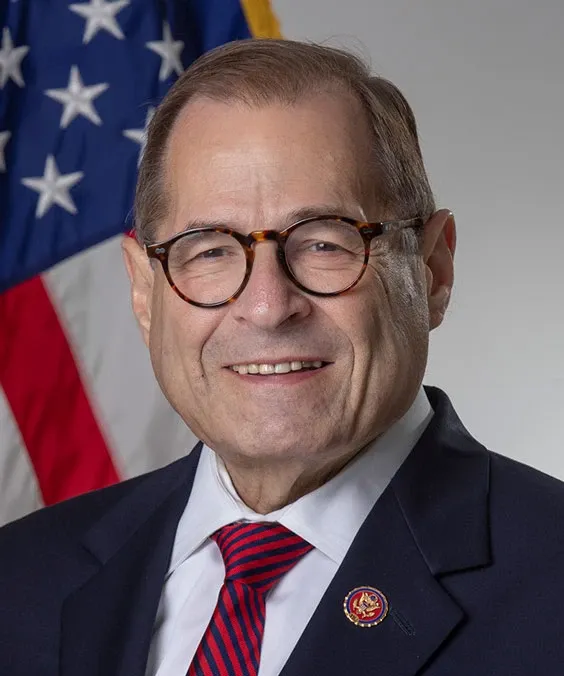
Hakeem Jeffries
The Public Record
Hakeem Sekou Jeffries is an American lawyer and politician currently serving as the U.S. Representative for New York's 8th congressional district, a position he has held since January 3, 2013. A member of the Democratic Party, Jeffries has been an influential figure in the House of Representatives, serving as the House Democratic Caucus Chair since 2019. He is known for his advocacy on issues such as criminal justice reform, healthcare, and economic equity.
Oct 21, 2015
But some certainty of punishment absent cooperation is very, very valuable in eliciting cooperation.
Oct 7, 2015
That is part of Silicon Alley. I am so glad that you are familiar with our East Coast lingo. But it also has more college students in downtown Brooklyn than Boston and Cambridge combined. So there has been a great number of young people…
Oct 7, 2015
And yet no one has presented a shred of evidence, a scintilla of evidence that Planned Parenthood has done anything wrong.
Oct 7, 2015
This is an enormous waste of taxpayer money for us to sit here at this hearing when we realize or should realize this is not a legitimate congressional exercise.
Oct 7, 2015
This is theater. This is a charade. This is stagecraft. This is nothing more than a political hit job on a woman's right to choose, which, by the way, is constitutionally protected.
Oct 6, 2015
Would you agree that whether there's been an impact over the course of your life in terms of outcome, that's the most important factor as to whether the investment in Head Start has yielded a return?
Sep 30, 2015
From the moment that House Republicans came to power, the majority has failed to do its job. They have consistently abdicated their responsibility to govern. They have consistently taken the American people on reckless legislative joyrides…
Jul 14, 2015
It is time to change the name, change the attitude and the approach, and recognize that we need to engage in reform.
Jul 14, 2015
We need to also examine reforms that are smart on crime but also protect public safety.
Jul 13, 2015
Many within the technology sector have indicated that there's approximately a 20 percent vacancy rate, if not more, of jobs that they cannot fill here in America.
Jul 13, 2015
Is it reasonable to have a priority policy that focuses on those undocumented immigrants who would potentially pose the most danger to the American citizens?
Jul 7, 2015
I thank the distinguished gentlewoman for her support. Mr. Chairman, I yield back the balance of my time. The Acting CHAIR. The question is on the amendment offered by the gentleman from New York (Mr. Jeffries). The amendment was agreed…
Jul 7, 2015
I have an amendment at the desk. The Acting CHAIR. The Clerk will report the amendment. The Clerk read as follows: At the end of the bill (before the short title), insert the following: limitation on use of funds Sec. __. None of the funds…
Jun 24, 2015
There is a moment now to have a discussion related to the specific military installations and whether it is appropriate for those installations to be named after individuals who were fighting to uphold the institution of slavery.
Jun 16, 2015
The rule that we are discussing today was first put forth in 2010. Is that correct?
Jun 10, 2015
I am worried about the underpinning of the public sector continuing what it needs to match the private sector.
Jun 3, 2015
I have an amendment at the desk. The Acting CHAIR. The Clerk will report the amendment. The Clerk read as follows: At the end of the bill (before the short title), insert the following: Sec. __. None of the funds made available by this Act…
Jun 1, 2015
We may not always agree on your particular positions but your contribution to the public square has been notable and significant.
May 18, 2015
We cannot ignore the fact that we have a problem in some instances with excessive use of police force.
May 18, 2015
What people want is to make sure that the constitutional principle of equal protection under the law applies to everyone.
Apr 14, 2015
I thank the distinguished gentleman from New Orleans for his thoughtful and eloquent exposition of the situation and for pointing out that, while this is not an easy conversation for us to have around the police's use of excessive force…
Apr 13, 2015
I think we could all agree that the litigation system is an important part of our democracy in the context of making sure that we resolve disputes in a manner consistent with the rule of law.
Mar 24, 2015
But putting that small fact aside for a moment, you don't think that the FCC's decision had anything to do with public sentiment, which I gather in a representative democracy is pretty important?
Politicians like Hakeem Jeffries