From that hour to this, there has been no disproval of the truth of these charges or of the righteousness of the resistance to which our forefathers resorted.
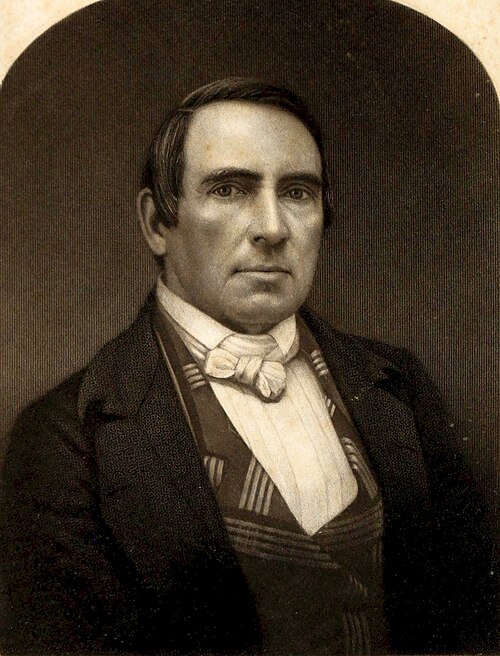
James Blaine
The Public Record
James Gillespie Blaine was an American statesman and Republican politician who represented Maine in the United States House of Representatives from 1863 to 1876, served as Speaker of the House from 1869 to 1875, and was a United States senator from 1876 to 1881. He served twice as Secretary of State, under presidents James A. Garfield and Chester A. Arthur in 1881, and under Benjamin Harrison from 1889 to 1892. He sought the Republican presidential nomination in 1876 and 1880, and received the nomination in 1884, narrowly losing the general election to Democratic nominee Grover Cleveland. Blaine was a prominent figure in the moderate faction of the Republican Party, known as the "Half-Breeds".
gutenberg.org
Jefferson and his fellow-patriots in that great Act proceeded to submit their proof to the judgment of a candid world.
When South Carolina attempted, somewhat after the illustrious model of the Declaration of Independence, to present justifying reasons for her course, the very authors of the document must have seen that it amounted only to a parody.
But these were all public policies which had been in operation with Southern consent and largely with Southern support, throughout the existence of the Republic.
South Carolina presented, as a special outrage, the enactment of personal-liberty bills in the free States, and yet, from the foundation of the Federal Government, she had probably never lost a slave in consequence of these enactments.
The omission by individual senators to present the grievances which justified secession is perhaps less notable then the same omission by the conventions which ordained secession in the several States.
They would not accept the honorable assurance of the Republican party and of the President-elect that no interference with slavery in the States was designed.
If now the danger was especially imminent, Southern leaders were solely to blame.
Not one of them deemed it necessary to justify his conduct by a recital of the grounds on which so momentous a step could bear the test of historic examination.
While these motives and aims are intelligible, it seems utterly incredible that not one of the senators gave a specification of the wrongs which led the South to her rash step.
South Carolina had taken the fatal step, and to fail in sustaining her would be to co-operate in crushing her.
If they had advised the Southern States that it was wiser and better to abide in the Union, and at least to wait for some overt act of wrong against the slave States, the whole movement would have collapsed.
In all the speeches delivered by the senators from the seceding States, there was no presentation of the grievances which, in their own minds, justified secession.
By some mysterious process still unexplained, the more they gained from connection with the National authority, the less was their obligation thereto, the more perfect their right to disregard and destroy the beneficent government which…
All these States apparently regarded the tie that bound them to the National Government as in no degree mutual, as imposing no duty upon them.
Their philosophy seems to have been that the General Government had been paid in full by the privilege of nurturing new States, of improving their rivers and harbors, of building their fortifications, of protecting them in peace, of…
The United States might or might not admit Louisiana to the Union, for the General Government was sole judge as to time and expediency--but when once admitted, the power of the State was greater than the power of the Government which…
No one could maintain that Louisiana had ever enjoyed a separate sovereignty of any kind, nominal or real.
Whatever specious plea might be made for the independent and separate sovereignty of the old thirteen States, the argument could not apply to Louisiana.
The State of Louisiana was formed from territory which had been bought and paid for by the United States out of the common treasury of the whole people.
What will you be when emasculated by the withdrawal of fifteen States, and warred upon by them with active and inveterate hostility?
This will be war, and we shall meet it with different but equally efficient weapons.
Lincoln as "an enemy to the human race, deserving the execration of all mankind.
I will have equality or war." He denounced Mr.
He expressed himself as against the theory of nullification, and explained that, so far from being identified with secession, the two are antagonistic principles.
Politicians like James Blaine