Why require protection where you will have nothing to protect? . . .
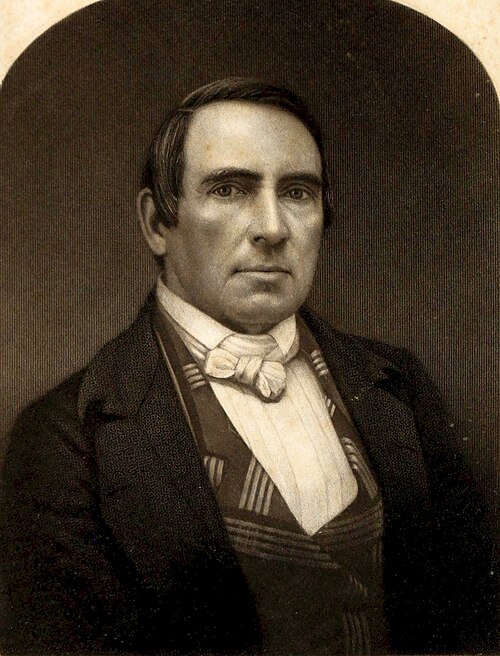
James Blaine
The Public Record
James Gillespie Blaine was an American statesman and Republican politician who represented Maine in the United States House of Representatives from 1863 to 1876, served as Speaker of the House from 1869 to 1875, and was a United States senator from 1876 to 1881. He served twice as Secretary of State, under presidents James A. Garfield and Chester A. Arthur in 1881, and under Benjamin Harrison from 1889 to 1892. He sought the Republican presidential nomination in 1876 and 1880, and received the nomination in 1884, narrowly losing the general election to Democratic nominee Grover Cleveland. Blaine was a prominent figure in the moderate faction of the Republican Party, known as the "Half-Breeds".
gutenberg.org
You decline to take the offer because you fear it will do you no good.
We offer to settle the question finally in all of the present territory that you claim, by giving you every chance of establishing Slavery that you have any right to require of us.
But the plea carried with it a national guaranty and protection of slavery on the southern side of the line, and its effect would inevitably have been in a few years to divide the Republic from ocean to ocean.
Every form of compromise which could be suggested, every concession of Northern prejudice and every surrender of Northern pride, was urged upon the committee.
The anxiety in both Senate and House to do something which should allay the excitement in the slave-holding section served only to develop and increase its exasperation and its resolution.
If the wild precipitation of the Southern leaders must be condemned, the compromising course of the majority in each branch of Congress will not escape censure,--censure for misjudgment, not for wrong intention.
Unwillingness to submit to Constitutional authority was the controlling consideration which drove the Southern States to the desperate design of a revolution, peaceful they hoped it would be, but to a revolution even if it should be one of…
They had been so long in command that they had become incapable of obedience.
They had been trained to lead and not to follow.
They had been too long accustomed to power to surrender it to an adverse majority, however lawful or constitutional that majority might be.
The political revolution of 1860 had given to the Republic an anti-slavery President, and the Southern men refused to accept the result.
No President of any party had ever been elected who was opposed to its supremacy.
It was, in short, an oligarchy which by its combined power ruled the Republic.
The nobles of Poland who dictated the policy of the kingdom were as numerous in proportion to the whole population as the rich class of slave-holders whose decrees governed the policy of their States.
Besides the distinction of free and slave, or black and white, there was another line of demarcation between white men that was as absolute as the division between patrician and plebeian.
The slave-holders ruled their States more positively than ever the aristocratic classes ruled England.
Its authors were not afraid of an immediate invasion of the rights of the slave-holder in the States, but they were conscious that the growth of the country, the progress of civilization, and the expansion of our population, were all…
This position disclosed the real though not the avowed cause of the secession movement.
The rights of slavery in the Territories required judicial confirmation, and the Supreme Court complied by rendering the famous decision in the case of Dred Scott.
The Missouri Compromise, passed with the consent and support of the South, was repealed by Southern dictation the moment its operation was found to be hostile to the spread of slavery.
More stringent provisions for the return of fugitive slaves were asked, and a law was enacted trampling under foot the very spirit of liberty, and putting in peril the freedom of men who were citizens of Northern States.
The acquisition of Louisiana, the purchase of Florida, the Mexican war, were all great national movements which resulted in strengthening the slave power.
On the other hand, the policy of the government had been steadily in favor of slavery; and the measures of Congress which would strengthen it were not only numerous, but momentous in character.
It would have been well for the dignity of the Southern Confederacy in history if one of its many able men had placed on record, in an authentic form, the grounds upon which, and the grievances for which, destruction of the Union could be…
Politicians like James Blaine