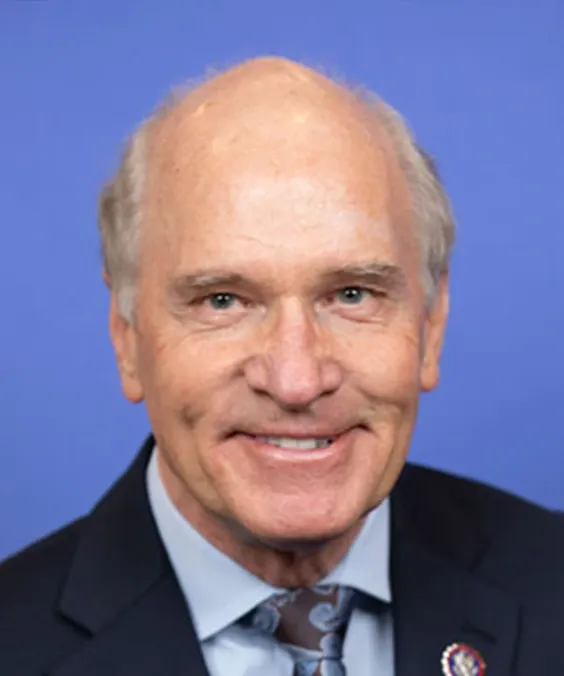
Jim McGovern
The Public Record
Jim McGovern is a Democratic member of the United States House of Representatives, representing Massachusetts's 2nd congressional district since 1997. He has been a strong advocate for issues such as hunger, human rights, and healthcare. Throughout his tenure, McGovern has focused on policies aimed at reducing food insecurity and promoting social justice. He has also been involved in various legislative efforts to improve access to healthcare for all Americans.
Jan 19, 2022
Our producers have spent decades showing the world that they are the answer to reducing global greenhouse gas emissions, and they are not the problem.
Jan 19, 2022
We need greater certainty and supply chain resiliency for both producers and consumers.
Jan 19, 2022
I know all of us in both parties realize and are motivated by this tremendous responsibility.
Jan 18, 2022
I think there needs to be a better coordinated effort to look at things more holistically.
Jan 18, 2022
I think you challenge us to think bigger and more holistically, which is something that is always very difficult to do.
Jan 18, 2022
You know, Dr. Burgess wax nostalgic about the previous administration. I look back on the early days of this crisis with a lot of shock that scientists were telling us that we had to take this pandemic seriously.
Jan 18, 2022
I think I speak for all of us on this panel: I go home; I am still trying to convince people to make sure they get the vaccine.
Jan 18, 2022
We are not very good at coordination between the House and the Senate, never mind the Federal Government, the State and local governments, and others that need to be part of it.
Jan 18, 2022
We are not particularly good at things like planning, which is essential, or coordination.
Jan 18, 2022
This has been a really interesting conversation on a very, very important topic.
Jan 11, 2022
This year's WRDA has the potential to build significantly on the Bipartisan Infrastructure Law to ensure that one of our most precious natural resources receives the investments and attention it deserves.
Jan 11, 2022
For 15 years, I have worked tirelessly with dedicated stakeholders in my district to make the Sacramento region as safe as possible for all residents.
Jan 11, 2022
Certainty in this will be critical in flood control planning not only for my constituents but potentially for non-federal project sponsors elsewhere.
Dec 22, 2021
So my question is you`ve had 84 days since that interview to go back and check the records. So when did you speak with the former president on January 6th? Did you talk to the former president before, during or after the attack in the…
Dec 6, 2021
Thank you, Mr. Chairman, for convening this hearing on the Chinese government and party's coercive use of its economic might to pursue its political objectives and to silence critics.
Dec 6, 2021
The options appear to be neither simple nor easy, and will require careful and considerate diplomacy with international partners.
Dec 6, 2021
It's essential that we respond. A huge thank you to the Women's Tennis Association for being very powerful in its response to Ms. Peng's treatment.
Dec 6, 2021
I'll tell you what's not in keeping with the Olympic spirit of uplifting humanity, and that's crushing humanity by stripping people of their political rights and engaging in genocide.
Dec 6, 2021
A huge thank you to the Biden administration for announcing yesterday a diplomatic boycott of the Olympic Games, and we must challenge every other nation in the free world to join us.
Nov 16, 2021
We cannot forget that the Chinese government's techno-authoritarianism is felt most gravely by the Uyghurs and other Turkic Muslims.
Nov 16, 2021
This concern is why the Commission, under my chairmanship in the last Congress, expanded its reporting to include 'Human Rights Violations in the United States and Globally.'
Nov 16, 2021
I look forward to the testimony today to help us work to identify the approaches that can harness technology in a way that respects rather than endangers fundamental human rights.
Politicians like Jim McGovern