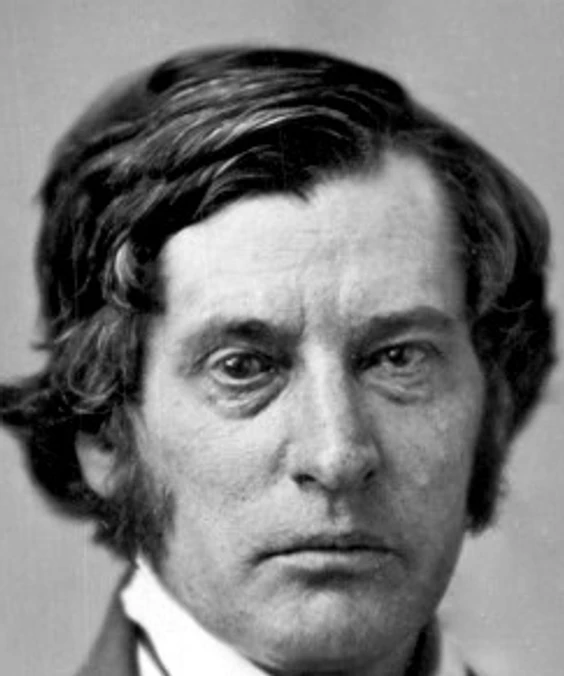
I account it one of the chief blessings of my life that my boyhood was spent in the pure, noble and simple society of the people of Concord.
George F. Hoar
The Public Record
gutenberg.org
We had none of the sweet patent medicines that the children now cry for, and none of the smooth capsules or the pleasant comfits that turn medicine into confectionery nowadays.
The horrible and nasty castor oil, ipecac and calomel, and the salts and senna, sulphur and molasses taken three mornings in succession and then missed three mornings, were worse than any sickness.
I do not know what the Jewish festival or the old Roman banquets might have been, but they could not have equalled a New England Thanksgiving week in a house in the country.
I do not believe there is a small boy's stomach in this generation that can hold a tenth part of what used to go into mine, not only on Thanksgiving day, but on the days before and after.
Thanksgiving was then, as it is and ought to be now, the great day of the year.
It was not uncommon to see farmers, bearing names highly respected in the town, lying drunk by the roadside on a summer afternoon, or staggering along the streets.
We discussed the situation with great gravity, and concluded that if the French beat us, we should have a king to rule over us.
I quite agree with Hosea Biglow when he says, "There is a fun to a Cornwallis, though; I aint agoin' to deny it.
The chief weapon of torture was the ferule, to the efficacy of which I can testify from much personal knowledge.
We understood the law to be that all apples that grew on the branches extending over the highway were public property, and I am afraid that when the owner was not about we were not very particular as to the boundary line.
I remember studying Caesar there with George Brooks, afterward judge, and reading with him an account of some battle where Caesar barely escaped being killed, on which Brooks's comment was "I wish to thunder he had been!
So you will understand how few lives separate you from the time when our country was born, and the time when all our people were British subjects.
They had heard John Buttrick's order to fire, which marked the moment when our country was born.
Let every critter jine To praise the eternal God.
The fireplace was the centre of the household, and was regarded as the type and symbol of the home.
No boy of that day will think there is any flavor like that of roast turkey and chicken or of the doughnuts and pancakes or griddle-cakes which were cooked by these open fires.
I am afraid the sympathy of the people who told the story was with the pump-maker and not with the lawyer.
I have no doubt a Roman boy two hundred years before Christ, or an Athenian boy four hundred years before Christ, lived quite as well as I did, if not better.
The Duke of Wellington used to say that the victory at Waterloo was won on the playing- fields at Eton.
The life and character of a country are determined in a large degree by the sports of its boys.
When the necessity was over, and the man or the boy in any generation got a college education, or was called to take part in public affairs, he rose at once and easily to the demands of an exalted station.
It is interesting to observe how little the character of the gentleman and gentlewoman in our New England people is affected by the pursuit, for generations, of humble occupations, which in other countries are deemed degrading.
It never occurred to the poorest that he must, for that reason, doff his hat to any man.
The richest man in town took an interest in the affairs of the poorest as in those of a kinsman.
Politicians like George F. Hoar