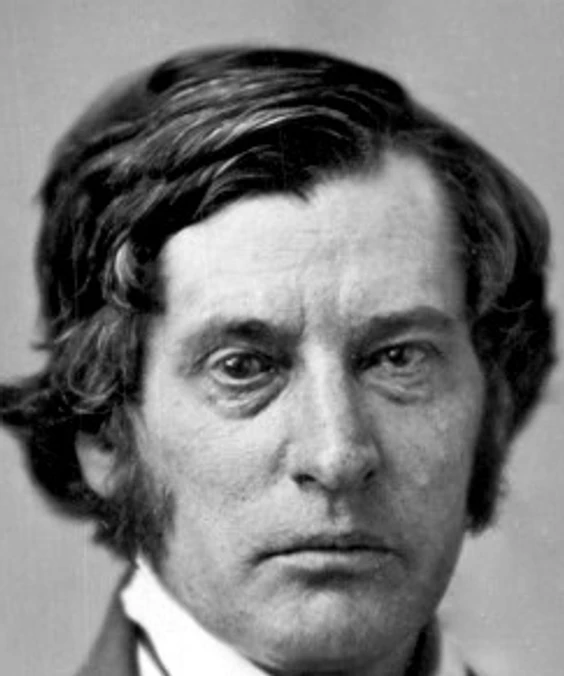
If you will only disfranchise him for the qualities which you say unfit him to vote and not for his race or the color of his skin there is no Constitutional obstacle in your way.
George F. Hoar
The Public Record
gutenberg.org
In my opinion, in all these race difficulties and troubles, the fault has been with the Anglo-Saxons.
First the Indian, then the Negro, then the Chinese, now the Filipino, disturb our peace.
It is a question which has vexed the American people from the beginning of their history.
I have had during my whole life to deal with that most difficult of all political problems, the relation to each other, in a Republic, of men of different races.
If you hold it at the will of the Nation, as expressed by the people of the whole Nation under the Constitution of the United States, then you are entitled to invoke the power of the United States for its enforcement whenever necessary.
If you hold the right at will of your State, then you can invoke no power but the State for its vindication.
What power can you invoke if that right be withheld from you?
The question upon which the policy of all National election laws depends is, At whose will do you hold your right to be an American citizen?
In other words, it is better to have the second best law kept permanently on the statute book than to have the best law there half the time.
If it only be maintained in force while one political party is in power, and repealed when its antagonist comes in, and is to be constant matter of political strife and sectional discussion, it is better, in my judgment, to abandon it than…
I am clearly of the opinion that Congress has the power to regulate the matter of elections of Members of the House of Representatives and to make suitable provisions for honest elections and an honest ascertainment of the result, and that…
There has never since been an attempt to protect National elections by National authority.
I think this is the last great outbreak of anger which has spread through the American people.
Its supporters were denounced by the Democratic papers everywhere, North and South, with a bitterness which I hardly knew before that the English language was capable of expressing.
The Election Bill deeply excited the whole country.
But I know that in heated political strife men of honor, even men of ability, sometimes deceive themselves by a casuistic reasoning which would not convince them at other times.
Not only a majority of the Republican Senators, but a majority of the whole Senate declared emphatically for an Election Bill.
It would drive back into the Democratic Party many men who were afraid of negro domination; who looked with great dislike on the assertion of National power over elections, and whom other considerations would induce to act with the…
It would be an exhibition of impotence, always injurious to a political party.
On reflection, I came myself to the conclusion that, while the Bill was reasonable and there was no reasonable doubt of the power of Congress to enact it, yet the attempt to pass it, if it were to fail, would do the cause infinite mischief.
They realized that the waning power of their party at the South, many of whose business men saw that the path of prosperity for the South as well as for the North lay in the adoption of Republican policies, might be reestablished by…
I had, myself, no doubt of the Constitutional authority of Congress, and of its duty, if it were able, to pass an effective law for that purpose.
The Republicans, who had elected President Harrison and a Republican House in 1888, were agreed, with very few exceptions, as to the duty of providing a remedy for this great wrong.
You deal with the Filipinos just as you deal with the negroes, only you treat them a heap worse.
Politicians like George F. Hoar