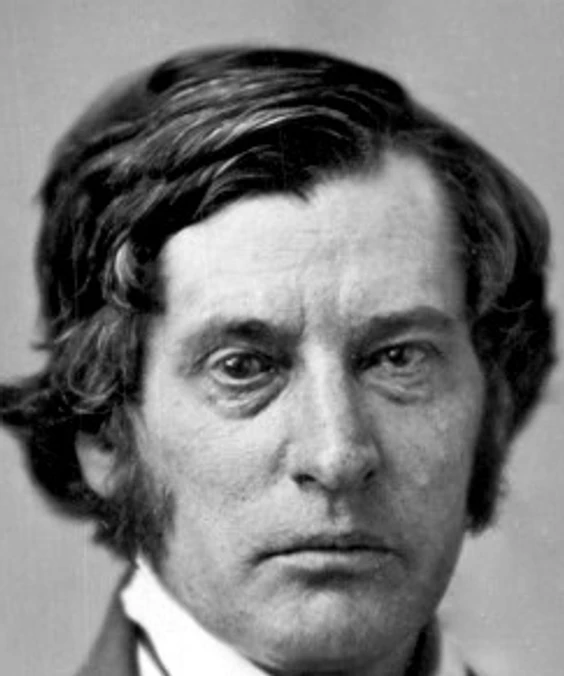
Or can General Wolseley cite an instance of individual genius and power more conspicuous than the relief of our besieged army at Chattanooga, the capture of six thousand prisoners, forty pieces of artillery, seven thousand stands of small…
George Boutwell
The Public Record
United States politician (1818–1905)
gutenberg.org
While General Lee was acting on the defensive did he engage in and successfully execute any strategic movement that can be compared with Grant's campaign of May, 1863, through Mississippi and to the rear of Vicksburg?
Following this remark I ought to say that General Meade was a brave and patriotic officer, but he lacked the qualities which enable a man to act promptly and wisely in great exigencies.
If this be so, then Lee's undertaking was a hazard for which there could have been no justifying reason, and his escape from destruction was due to the inadequacy of the men in command of the Northern armies.
It might have been impaired or crippled by the training of a university; but it is doubtful whether it could have been improved thereby, and it is certain that it was, in its quality, quite outside of the possibilities of university…
Lincoln was such a man in speech, in power of argument, in practical wisdom, by which he was enabled to act fearlessly and with success in the great affairs of administration.
In truth, a really great man is supreme over college and universities.
Great men are independent of colleges and universities.
That minority of critics did not realize the fact that colleges and universities cannot make great men.
That minority of critics overlooked the fact that the world had set the seal of its favorable judgment upon Cromwell, Washington, Franklin, Napoleon, Hamilton and others who had not the advantages of university training.
An opinion existed in the cultivated classes, an opinion that was especially local in the East, that a great place could not be filled wisely and honorably, unless the occupant had had the benefit of a university training.
It is a precious souvenir of my acquaintance and service with a man who was great and good above any estimate that the world has placed upon him.
I am not willing knowingly to do anyone injustice as I now am led to believe I may have done in the case of General Egan.
Again he said to me that his final campaign against Vicksburg was the only one of his campaigns that he could not criticise adversely when tested by reflection and experience.
General Grant's sense of justice was exact and he did not spare himself in his criticism.
When the Ku Klux organizations were active in the South, the President gave members of Congress to understand that he would send a message with a recommendation for punitive legislation.
With him there could be no genuine forgiveness, and his nature could not tolerate any degree of hypocrisy.
He was sincere and devoted in his friendships, but when he discovered that his confidence had been misplaced, a reconciliation became impossible.
My intercourse with General Grant was intimate through many years, and never on any occasion did he repeat a story or a phrase that contained a profane remark or carried a vulgar allusion.
The purity of his conversation might have been a worthy example for the most carefully trained person in etiquette and morals.
There was never in his career any ostentatious display of power, never any exercise of wanton or unnecessary authority.
The simplicity of General Grant's nature, his frankness in all his intercourse with his fellow men, his freedom from duplicity were not touched unfavorably in any degree by his rapid advancement from the ordinary pursuits of ordinary men…
Garfield was of the citizen soldiery and to him and to the country the etiquette of the army and the etiquette of society were subordinate to the fortunes of the nation.
The struggle was a desperate one and the volunteer army was composed of men who were citizens before they were soldiers and they remained citizens when they became soldiers.
He chose his place early and firmly on the anti-slavery side, but it is absurd and false to say that thenceforward and therefor abolitionism became popular and abolitionists the sought for or the accepted by society.
Politicians like George Boutwell