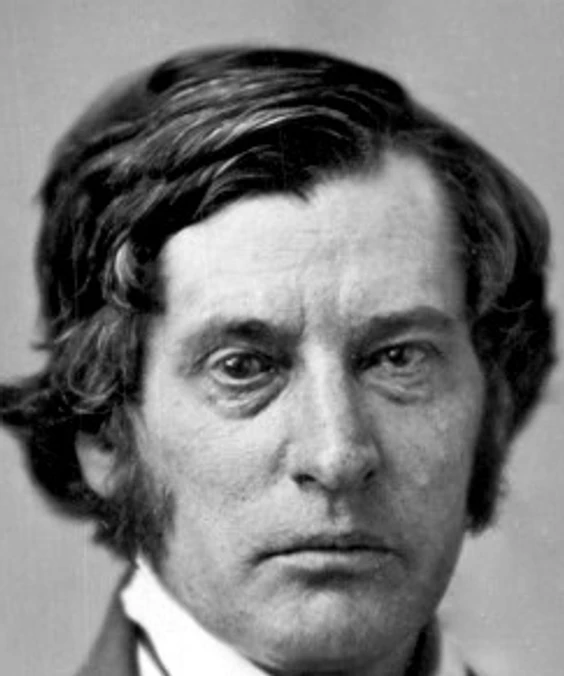
The repudiation of the Public Debt is not a matter of expectation or fear, it is a matter of certainty, if you assent to any reconstruction of this Union through the instrumentality of Jefferson Davis and his associates.
George Boutwell
The Public Record
United States politician (1818–1905)
gutenberg.org
Therefore I say that by the reconstruction some men desire you render secession certain, bankruptcy throughout the North certain.
When you have permitted Jefferson Davis and his associates to come back and take their places in the government of this country, do you not see that with the help of a small number of representatives from the North whose services they are…
But suppose that what some gentlemen desire could be accomplished,--a reconstruction of the Union by diplomatic relations inaugurated between this Government and Jefferson Davis'--suppose the South should return--what follows?
Therefore, if you abandon this contest now, it is separation--that is what is meant, and nothing else can follow.
Will not Jefferson Davis and his associates understand that when we have ceased to make war, when our armies become demoralized, public sentiment relaxed, when they have had opportunity to gather up the materials for prosecuting this…
They of the North who give aid and comfort to the enemy deserve to monopolize in the application all the harsh words and phrases of the English language. (Applause.) Cessation of hostilities--what follows?
Do not longer employ the harsh language which you can command in denunciation of Southern traitors.
They made war with some pretence on their part for a reason for war, but what excuse, what palliation is there for those men in the North, who, regardless of liberty, of justice, and of humanity, ally themselves, openly some and secretly…
The soldiers are true to the flag and they will fight on and march on until the last rebel has fallen to the dust or laid down his arms.
If it was true on the 30th day of last month that the people of this country ought to take immediate efforts for the cessation of hostilities, then, gentlemen, we have cause to mourn rather than to rejoice.
Fellow Citizens: It depends very much upon what we believe as to the future of this country and the rights of the people, whether we rejoice or mourn in consequence of the events in Mobile Bay and before Atlanta.
I had one fixed resolution--I should get a hearing or I should spend the night in the hall.
Hard words should not be used and nothing should be said of a partisan character.
Strange as the fact may now appear, those historical events were not accepted with satisfaction by all the citizens of Boston.
Lincoln had genius for the work of composition, and the poetic quality was strong and it was often exhibited in his speeches and writings.
He had one essential quality of leadership--a strong will.
Chase's lack of resolution gave me an unfavorable impression of his ability for administrative affairs.
I cannot doubt that an unwholesome change in the use of money in elections has taken place in the last fifty years.
If the statements now made frequently and boldly, are truthful statements, then we are moving towards a condition of affairs when the offices of government will be divided between rich men and men who seek office for the purpose of…
There are proper uses for money in political contests, but candidates should not be required to make contributions in return for support.
If the statements are trustworthy that have been made publicly in recent years the conclusion cannot be avoided that money is used in elections for corrupt purposes--sometimes to secure nominations and sometimes to secure elections, when…
Adequate salaries would not prevent speculation on the part of public officers, but they could not offer as an excuse for their acts the meager salaries allowed by the government.
All these efforts are adverse to the public interests and often the proceedings are tainted with corruption.
This fact furnishes a pretext for efforts to make money while in the public service.
Politicians like George Boutwell