EPA is pushing a back door cap-and-trade policy without congressional approval.
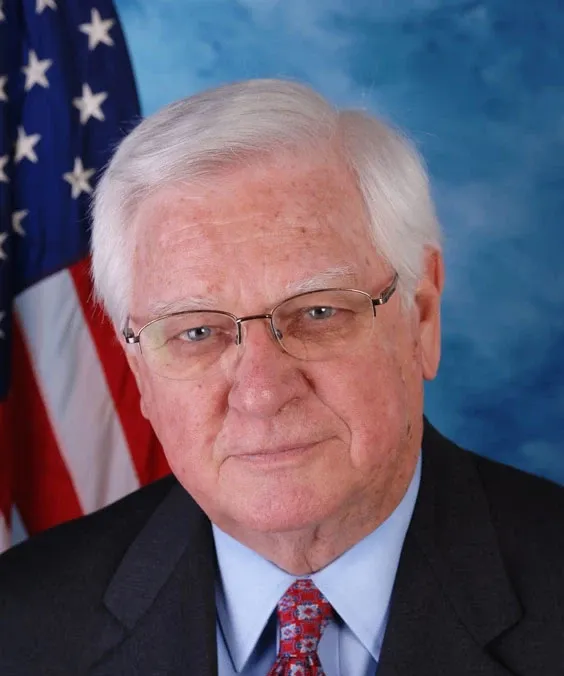
Ed Whitfield
The Public Record
Ed Whitfield is a former Republican member of the United States House of Representatives, who served Kentucky's 1st congressional district from 1995 to 2017. During his tenure, he was known for his work on energy and commerce issues, particularly in relation to the energy sector and healthcare. Whitfield played a significant role in various legislative efforts, including those aimed at reforming the Affordable Care Act and addressing energy policy in the United States. He was also involved in initiatives related to veterans' affairs and agriculture, reflecting the interests of his constituents in rural Kentucky.
★ Featured Quote
July 5, 2016
EPA has created a de facto fuel and renewable energy standard for America.
— Ed Whitfield
Most widely reported
by number of sources- today the United States House of Representatives begins debate on Articles of Impeachment of President William Jefferson Clinton2 sources1997congress.gov
- while I am not a member of the Committee on the Judiciary, I came to this debate today with the great hope that the advocates for the President would spend considerable time addressing specifically the articles of impeachment2 sources1997congress.gov
- I certainly want to thank the gentleman from Tennessee for offering this amendment and particularly pointing out that it relates to animals as well as people, and I would say that from our analysis, certainly EPA considers work-related illnesses and absences when they issue these regulations, and the specific section of the bill, H.R. 2681, which the gentleman from Tennessee is amending relates to the provisions that the administrator must consider relating to the industry in trying to comply with the regulation. This amendment would add to that illness-related work absences would have to be considered as well, and we think that that would really be duplicative of what they already considered. And because of that, despite the great respect we have for the gentleman from Tennessee, I would urge that this amendment not be adopted and urge other Members to vote ``no'' on the amendment. I yield back the balance of my time.2 sources2011govinfo.gov
- We have heard a lot of discussions today about how important it is with a clean energy plan to address CO<INF>2</INF> emissions in the U.S. You would think that this clean energy plan is going to make a tremendous difference. I would just like to point out that the Energy Information Administration recently reported that U.S. energy-related CO<INF>2</INF> emissions will remain flat through 2040 and below their 2005 levels without the clean energy plan. So this clean energy plan is being elevated to do some dramatic good. The fact is the U.S. is already doing more than most countries. And I would point out that, in the coming decades, more than two-thirds of the world's energy-related CO<INF>2</INF> emissions will come from the developing countries of the world. So we are being penalized in America, although we have already made great strides. That is why we are trying to give States more time to address this very complex regulation. At this time, I yield 3 minutes to the distinguished gentleman from Ohio (Mr. Johnson), who is a member of the Energy and Commerce Committee.2 sources2015govinfo.gov
Despite the stay of the Clean Power Plan, last week EPA published a 44-page proposed rule setting forth the details for Clean Energy Incentive Program.
So many critics say that that flexibility argument--we're giving maximum flexibility to the State--is really a red herring.
I want clean air. I want clean water. But I don't want an organized attack on the energy-producing sector of America because of, to use Mr. McNerney's term, a political decision to go after hydrocarbons.
There are strong feelings on the issue because many people, and we are speaking for our constituents, believe that EPA is exceeding its legal authority under the direction of a president who is trying to impose his will on climate change…
This administration is engaged in favoritism as it pursues its carbon future for America.
Well, some States would disagree with that. I've talked to many of them, and they view--even though you went through a process, that you set the standard.
Amen. I was just in China and we saw their reports in the local press. They're building new power plants they know they don't need. They just want the jobs, more coal emissions. So, again, it's a global challenge. It's not just America's…
If that happens and if you're still at the EPA I want you to go to Fairfield, Texas with Congressman Bill Flores and explain to those people who've lost their jobs how you've improved their environment.
27 States filed a lawsuit against the Clean Power Plan, and the Supreme Court issued a stay.
During the almost 6 years that I have been chairman of this subcommittee, we've had 40 hearings that have looked at various EPA rules and proposals that affect or will affect the Nation's energy and industrial sectors.
Congress did not write the Clean Air Act to provide EPA with the ability to create new regulatory powers and authorities so it can transform the Nation's energy system.
However, most of this trend is due to sharply increased domestic oil production--something that few imagined was even possible during the Congressional debates over the RFS.
there is an immense loss of wildlife habitat where because of the incentives that Congress has passed...
In order to reach Congress' statutory volumes there needs to be more ethanol in the system than can be absorbed just through E10.
We must do more to decrease our dependence on foreign oil and expand our use of renewable energy sources that boost economic development in our rural areas...
My bill, the Renewable Fuel Utilization, Expansion, and Leadership Act, or REFUEL, will create a new and retrofit existing infrastructure including pumps for biofuels and hydrogen tanks, piping, and electric vehicle chargers...
The RFS was also supposed to provide a means for significantly reducing greenhouse gas emissions, but a growing number of scientists and environmental advocates are saying otherwise.
As I see it, the RFS was enacted largely for three reasons--to reduce America's dependence on foreign oil, to lower greenhouse gas emissions, and to strengthen rural economies.