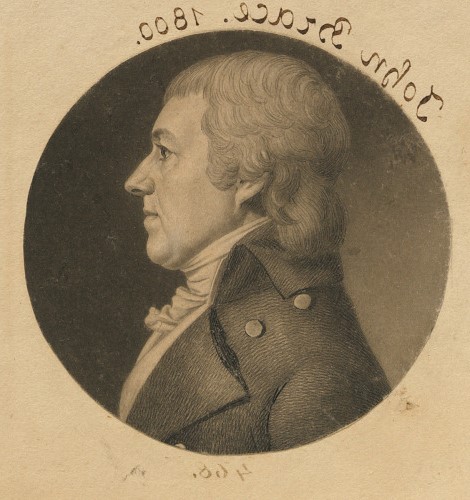
It is not enough to tell us that men will be selected of more virtue and talents than those now in power--such a pretence is vain--no man in his senses will regard it--no man makes such a pretence but for wicked purpose.
David Daggett
The Public Record
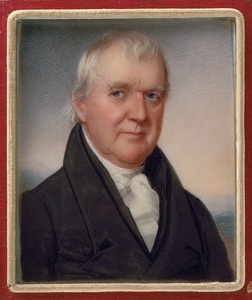
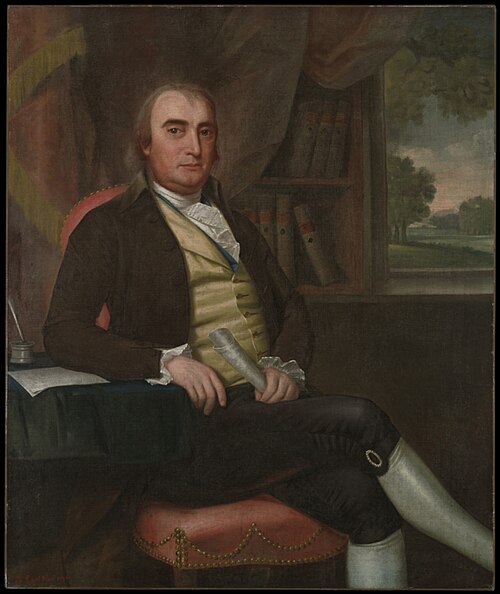
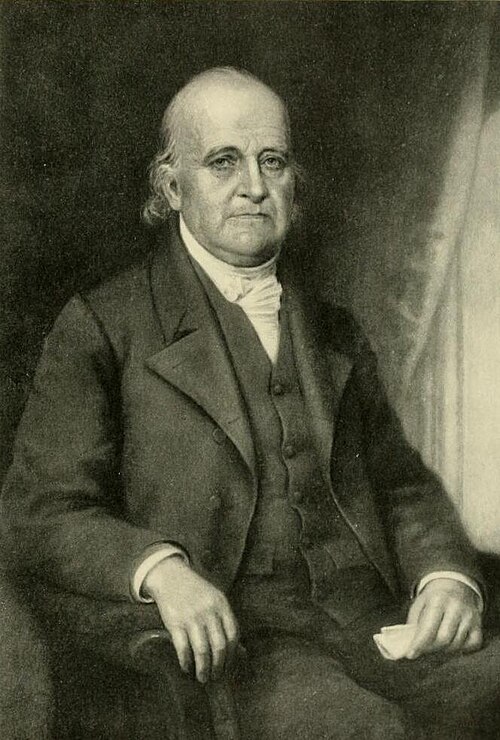
David Daggett was a U.S. senator, mayor of New Haven, Connecticut, Judge of the Connecticut Supreme Court of Errors, and a founder of the Yale Law School. He helped block plans for the first college for African Americans in the United States and presided over the conviction of a woman running a boarding school for African Americans in violation of Connecticut's recently passed Black Law. He judged African Americans not to be citizens and supported their colonization to Africa.
gutenberg.org
To those who respect the authority of God it is a matter of no small moment that those who rule over men should be just, ruling in the fear of God nor will men, accustomed to revere this solemn declaration, lend their aid to elevate men of…
The men who are to stand in the places of our Trumbulls and our Ellsworths should not shrink from public investigation.
But, my countrymen, before you join in this project, pause and enquire, who are these men who thus assert their claim to rule over you?
Another favorite scheme is to elevate to all the offices of importance men who have never enjoyed the public confidence.
Yet the stripling of yesterday--the bold projector--the unprincipled ad ambitious, with a host of deceived followers, with matchless effrontery, arraign the conduct of these magistrates and loudly demand that they be driven from their…
Are they not filled with men of incorruptible integrity?
Without this, liberty can exist only in name--The name indeed may be blasphemously uttered, but the substance is gone with the liberty of all who have relied on professions.
Is not a wise and faithful execution of the laws the chief object of every good Government?
Against these men the cry is raised--not the cry of the oppressed, for God knows no man in Connecticut is oppressed, but the cry of those who pant for office, and who can rise only on the ruins of others.
There is another, who, for more than twenty years has been employed in the first offices in the gift of his country, and whose probity and talents are second to those of none of his contemporaries.
Among them there is one who was side by side with your beloved Washington during the revolutionary war, who has repeatedly been elected your first magistrate, and, against whom, the tongue of slander never moved but in the hard service of…
A candid observer must reply, they are men in whose hands power has been wisely placed by the people, and who have never abused that power, men of unquestionable talents and of spotless fame.
Let men who wish to protect their invaluable rights ponder on these things, and let them at the same time, remember that no nation in which universal suffrage hath been allowed, hath remained free and happy.
It is nothing less than an effort to rest from the farmers of Connecticut that controul over the elections which is their only fortress of safety.
They are lords of their own soil, and of course, to a certain degree, independent--they therefore will resist tyranny--they will equally oppose anarchy because they are aware that in any storm which may arise they must abide its fury.
Landholders have an enduring interest in the welfare of the community.
Again, it is insisted by those who oppose universal suffrage, and the reader is desired to notice the remark with attention, that no community can be safe unless the power of elections resides principally with the great body of the…
No one pleads for such a privilege, but there are many who insist that the man without a cent of property shall have the same direction in the choice of those who are charged with the interests of the community, as he who is worth…
In this view of the subject the maxim is wise and just.
This State and the other States understood this maxim precisely as now explained, in their opposition to Great-Britain.--We complained that the colonies should not be taxed because they were not represented in parliament.
What then is the true meaning of the maxim, that representation and taxation are inseparable?
For more than a century we have preserved an unexampled prosperity.--shall we hazard our interests on the speculations of zealous partizans who are constantly bewildering themselves and their followers in new schemes?
Experience, the only save and unerring guide, is altogether in favor of elections at large rather than by Districts.
It is of no moment where a man dwells, but it is of immense importance that he be a wise man rather than a fool--a man of integrity rather than a knave.
Politicians like David Daggett