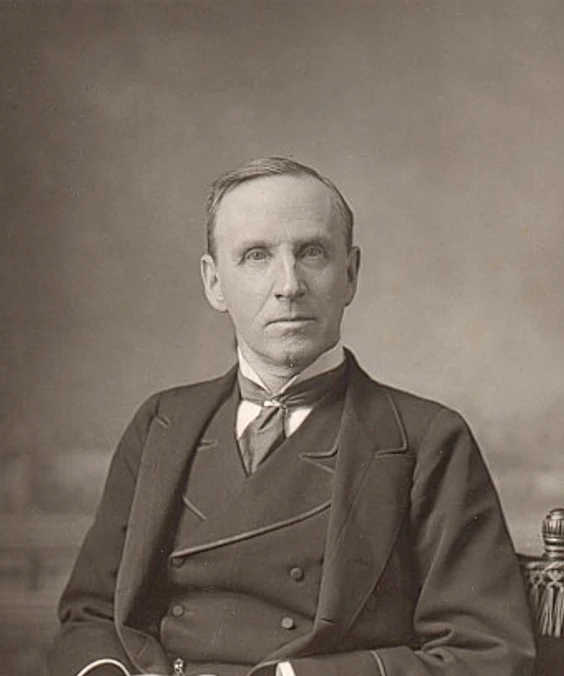
I do not agree with him in his choice of ends, but he is an almost perfect master of methods and means.
Walter Bagehot
The Public Record
Walter Bagehot was an English journalist, businessman, and essayist, who wrote extensively about government, economics, literature and race. He is known for co-founding the National Review in 1855, and for his works The English Constitution and Lombard Street: A Description of the Money Market (1873).
gutenberg.org
The persons most ready to take up that sort of business are benevolent amateurs, very well intentioned, very grave, very respectable, but also rather dull.
Their words are good, but about the joints their arguments are weak.
Some thinkers have naturally suggested that the heads of departments should as such have the right of speech in the House.
A great popular assembly has a corporate character; it has its own privileges, prejudices, and notions.
And one of these notions is that its own members--the persons it sees every day--whose qualities it knows, whose minds it can test, are those whom it can most trust.
He will lose his head--he will say what he should not.
He will hate the House as naturally as the House does not like him.
He will be an incompetent speaker addressing a hostile audience.
And what is more, an outside administrator addressing Parliament can move Parliament only by the goodness of his arguments.
The natural mode in which a department is improved on great points and new points is by external suggestion; the worse foes of a department are the plausible errors which the most visible facts suggest, and which only half visible facts…
Both the good ideas and the bad ideas are sure to find advocates first in the press and then in Parliament.
I cannot afford to make enemies for those whom I did not appoint.
The incessant tyranny of Parliament over the public offices is prevented and can only be prevented by the appointment of a Parliamentary head, connected by close ties with the present Ministry and the ruling party in Parliament The…
So long as at any moment the policy of an office could be altered by chance votes in either House of Parliament, there is no security for any consistency.
But they would be much worse if any thirty or forty advocates for this gun or that gun could make a motion in Parliament, beat the department, and get their ships or their guns adopted.
The experiment of conducting the administration of a public department by an independent unsheltered authority has often been tried, and always failed.
The new law started upon a certain intellectual impetus, and till that was spent its administration was supported in a rickety existence by an abnormal strength.
The Commission had to be dissolved, and a Parliamentary head was added; the result is not perfect, but it is an amazing improvement on what would have happened in the old system.
The new system has not worked well because the central authority has too little power; but under the previous system the central authority was getting to have, and by this time would have had, no power at all.
Chadwick could not maintain an outlying department in the face of Parliament, how unlikely that an inferior compound of discretion and activity will ever maintain it!
These reasonings show why a changing Parliamentary head, a head changing as the Ministry changes, is a necessity of good Parliamentary government, and there is happily a natural provision that there will be such heads.
In America, where on account of the fixedly recurring presidential election, and the perpetual minor elections, party organisation is much more effectually organised than anywhere else, the effect on the offices is tremendous.
But till now the Americans have tried to get on not only with changing heads to a bureaucracy, as the English, but without any stable bureaucracy at all.
The progress of the military art is the most conspicuous, I was about to say the most SHOWY, fact in human history.
Politicians like Walter Bagehot