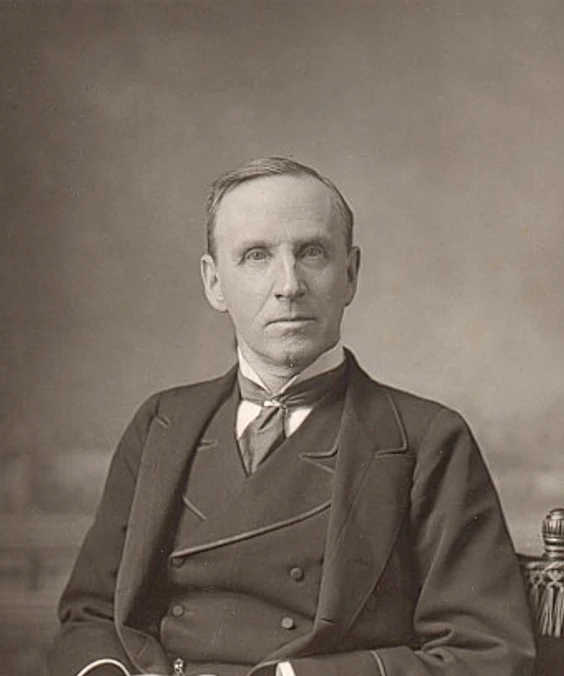
It would be to introduce compulsion into that in which freedom and existence are the same: I mean credit.
Edmund Burke
The Public Record
Edmund Burke was an Anglo-Irish writer, philosopher, and politician who is widely credited as the founder of the cultural and political philosophy of conservatism. Regarded as one of the most influential conservative thinkers and political writers of the 18th century, Burke spent the majority of his career in Great Britain and was elected as a member of Parliament (MP) from 1766 to 1794 in the House of Commons of Great Britain with the Whig Party. His writings played a significant role in influencing public views and opinions in both Great Britain and France following the French Revolution in 1789, and he remains a major figure in modern conservative circles.
gutenberg.org
But the compulsion ought to be known, and well defined, and well distinguished; for otherwise treaty only weakens the energy of compulsion, while compulsion destroys the freedom of a bargain.
The moment a man is exempted from the maintenance of the community, he is in a sort separated from it,--he loses the place of a citizen.
None on account of their dignity should be exempt; none (preserving due proportion) on account of the scantiness of their means.
It would throw upon one description of persons in the community that burden which ought by fair and equitable distribution to rest upon the whole.
In effect, it would be the most unjust and impolitic of all things,--unequal taxation.
To advance their money, they risk it; and the risk is to be included in the price.
For a small temporary benefit, the spring of all public credit might be relaxed forever.
To force that market, or any market, is of all things the most dangerous.
A corrupt and improvident loan, like everything else corrupt or prodigal, cannot be too much condemned; but there is a short-sighted parsimony still more fatal than an unforeseeing expense.
Secondly, it brings to light what, under the most discouraging appearances, I always reckoned on: that, with its ancient physical force, not only unimpaired, but augmented, its ancient spirit is still alive in the British nation.
In the first place, the loan demonstrates, in regard to instrumental resources, the competency of this kingdom to the assertion of the common cause, and to the maintenance and superintendence of that which it is its duty and its glory to…
The circumstances of the loan have proved beyond a doubt three capital points, which, if they are properly used, may be advantageous to the future liberty and happiness of mankind.
The effect on the enemy is not in what he may speculate on our resources, but in what he shall feel from our arms.
What does he find us, when he puts us to the proof of what English interest and English honor demand?
Let us descend into our own bosoms; let us ask ourselves what are our duties, and what are our means of discharging them.
The adversary must be judged, not by what we are, or by what we wish him to be, but by what we must know he actually is: unless we choose to shut our eyes and our ears to the uniform tenor of all his discourses, and to his uniform course…
This alone is a consideration of any importance; because all calculation formed upon a supposed relation of the habitudes of others to our own, under the present circumstances, is weak and fallacious.
My view of this was different: I liked the loan, not from the influence which it might have on the enemy, but on account of the temper which it indicated in our own people.
I am thoroughly satisfied, that, if we degrade ourselves, it is the degradation which will subject us to the yoke of necessity, and not that it is necessity which has brought on our degradation.
Necessity, as it has no law, so it has no shame.
The only excuse to be made for all our mendicant diplomacy is the same as in the case of all other mendicancy, namely, that it has been founded on absolute necessity.
Not where, under Providence, the hopes of Englishmen used to be placed, in our own courage and in our own virtues, but in the moderation and virtue of the most atrocious monsters that have ever disgraced and plagued mankind.
But to those very enemies who have sworn our destruction we have ourselves given a further and far better security, by rendering the cause of the royalists desperate.
This circumstance assures some degree of permanence to the power of those whom we know to be permanently our rancorous and implacable enemies.
Politicians like Edmund Burke