
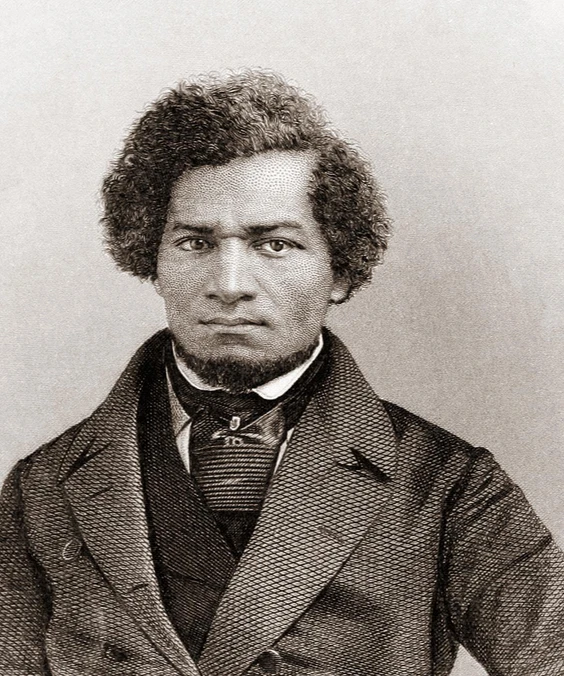

@frederickdouglass· Jan 1, 1855
This, to a hungry man, is not a prospect to be regarded with indifference.
From the public-domain record · 81,371 quotes
Founders, statesmen and world leaders — cited from their collected works.
The figures
This, to a hungry man, is not a prospect to be regarded with indifference.
It was not merely the agency of Master Thomas, in breaking up and destroying my Sabbath school, that shook my confidence in the power of southern religion to make men wiser or better; but I saw in him all the cruelty and meanness, after…
The reader will not be surprised when I say, that the breaking up of my Sabbath school, by these class-leaders, and professedly holy men, did not serve to strengthen my religious convictions.
I could not go to Baltimore, but I could make a little Baltimore here.
Here, thought I, is something worth living for; here is an excellent chance for usefulness; and I shall soon have a company of young friends, lovers of knowledge, like some of my Baltimore friends, from whom I now felt parted forever.
The whole community—with but a single exception, among the whites—frowned upon everything like imparting instruction either to slaves or to free colored persons.
They seemed almost as unconcerned about our getting to heaven, as they were about our getting out of slavery.
The natural wickedness of his heart had not been removed, but only reinforced, by the profession of religion.
If religion had any effect on his character at all, it made him more cruel and hateful in all his ways.
His religion, therefore, neither made him emancipate his slaves, nor caused him to treat them with greater humanity.
The highest evidence the slaveholder can give the slave of his acceptance with God, is the emancipation of his slaves.
Slaveholders may, sometimes, have confidence in the piety of some of their slaves; but the slaves seldom have confidence in the piety of their masters.
His conversion was not to change his relation toward men—at any rate not toward BLACK men—but toward God.
Slaves, too, readily distinguish between the birthright bearing of the original slaveholder and the assumed attitudes of the accidental slaveholder; and while they cannot respect either, they certainly despise the latter more than the…
Make a man a slave, and you rob him of moral responsibility.
Slaveholders I hold to be individually and collectively responsible for all the evils which grow out of the horrid relation, and I believe they will be so held at the judgment, in the sight of a just God.
If he steals, he takes his own; if he kills his master, he imitates only the heroes of the revolution.
Slaveholders have made it almost impossible for the slave to commit any crime, known either to the laws of God or to the laws of man.
The morality of free society can have no application to slave society.
It is this: Within the bounds of his just earnings, I hold that the slave is fully justified in helping himself to the gold and silver, and the best apparel of his master, or that of any other slaveholder; and that such taking is not…
As society has marked me out as privileged plunder, on the principle of self-preservation I am justified in plundering in turn.
Society at large has bound itself, in form and in fact, to assist Master Thomas in robbing me of my rightful liberty, and of the just reward of my labor; therefore, whatever rights I have against Master Thomas, I have, equally, against…