
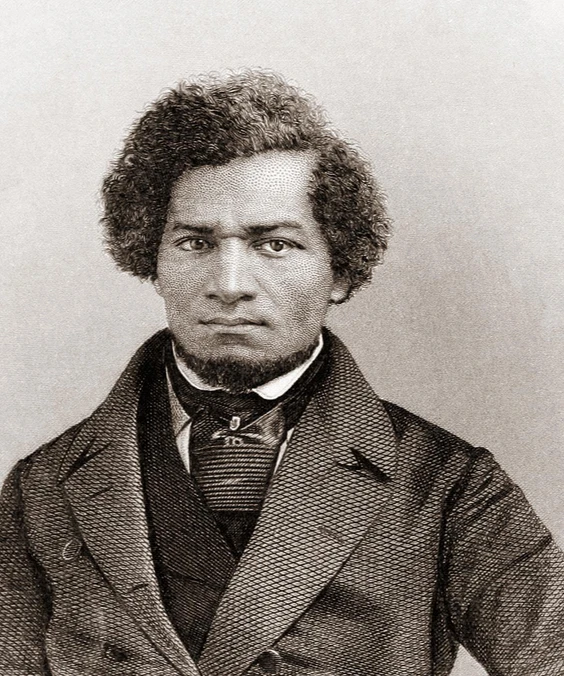

@frederickdouglass· Jan 1, 1855
Yet in the United States, human beings are thus branded.
From the public-domain record · 81,371 quotes
Founders, statesmen and world leaders — cited from their collected works.
The figures
Yet in the United States, human beings are thus branded.
Starvation, the bloody whip, the chain, the gag, the thumb-screw, cat-hauling, the cat-o’-nine-tails, the dungeon, the blood-hound, are all in requisition to keep the slave in his condition as a slave in the United States.
Suffice it to say, that all of the peculiar modes of torture that were resorted to in the West India islands, are resorted to, I believe, even more frequently, in the United States of America.
Three millions of people shut out from the light of knowledge!
If the father attempt to give his son a knowledge of letters, he may be punished by the whip in one instance, and in another be killed, at the discretion of the court.
If a mother shall teach her children to read, the law in Louisiana proclaims that she may be hanged by the neck.
This is American slavery; no marriage—no education—the light of the gospel shut out from the dark mind of the bondman—and he forbidden by law to learn to read.
If any of these three millions find for themselves companions, and prove themselves honest, upright, virtuous persons to each other, yet in these cases—few as I am bound to confess they are—the virtuous live in constant apprehension of…
What is to be thought of a nation boasting of its liberty, boasting of its humanity, boasting of its Christianity, boasting of its love of justice and purity, and yet having within its own borders three millions of persons denied by law…
The marriage institution cannot exist among slaves, and one-sixth of the population of democratic America is denied its privileges by the law of the land.
If his moral perception leads him in a course contrary to his value as property, the slaveholder declares he shall not exercise it.
God has given him an intellect; the slaveholder declares it shall not be cultivated.
Whatever of comfort is necessary to him for his body or soul that is inconsistent with his being property, is carefully wrested from him, not only by public opinion, but by the law of the country.
If he is clothed, it is with a view to the increase of his value as property.
The will and the wishes of the master are the law of the slave.
His own good, his conscience, his intellect, his affections, are all set aside by the master.
He is a piece of property—a marketable commodity, in the language of the law, to be bought or sold at the will and caprice of the master who claims him to be his property; he is spoken of, thought of, and treated as property.
The condition of a slave is simply that of the brute beast.
Slavery in the United States is the granting of that power by which one man exercises and enforces a right of property in the body and soul of another.
But I am here to say that I think the term slavery is sometimes abused by identifying it with that which it is not.
I have nothing to commend me to your consideration in the way of learning, nothing in the way of education, to entitle me to your attention; and you are aware that slavery is a very bad school for rearing teachers of morality and religion.
With such facts as these before me—and I have many of them—I am inclined to think that pride and fashion have much to do with the treatment commonly extended to colored people in the United States.