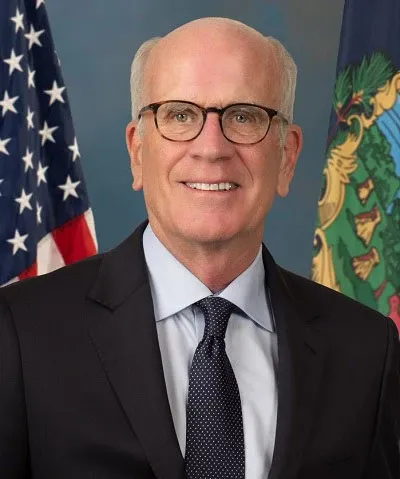
Patrick Leahy
The Public Record
Patrick Leahy is a former United States Senator from Vermont, serving from 1975 until 2023. A member of the Democratic Party, he was the longest-serving senator in Vermont's history and held significant leadership roles, including President pro tempore of the Senate. Throughout his tenure, Leahy was known for his work on issues such as civil liberties, health care, and environmental protection. He played a key role in various legislative efforts, including the Violence Against Women Act and initiatives to reform the criminal justice system.
Feb 27, 2012
Well, I hope it doesn't come to pass. As a bumper sticker slogan, talking about these kind of cuts sounds great.
Feb 27, 2012
I have long voiced my concerns with the way a few large U.S. contractors and nongovernmental organizations (NGOs) obtain the vast majority of USAID funding.
Feb 27, 2012
One important goal of the law is to end the impunity for members of foreign security forces who violate human rights.
Feb 27, 2012
It is against the law to provide any form of assistance--training, equipment, or anything else--to any person who either belongs to a unit credibly alleged to be involved in gross violations of human rights.
Feb 27, 2012
The Leahy amendment, which prohibits aid to units of foreign security forces that violate human rights, has some strong supporters in the State Department.
Feb 17, 2012
I appreciate the fact that the filibuster has been dropped on this very good man. This nomination has taken months to get here. I would urge everybody to vote for it.
Feb 14, 2012
The thing that surprised most people...was the fact that these vests do wear out.
Feb 14, 2012
I hope we can proceed to reauthorize the Bulletproof Vest Partnership grant program and other important law enforcement measures, and Congress will join together with one voice to send a strong, clear message to our Nation's law…
Feb 14, 2012
I am holding the hearing today because the Bulletproof Vest Partnership Grant Act expires in September, and I want you to know I will introduce legislation in the coming weeks to reauthorize this program.
Feb 14, 2012
Since we enacted the original Leahy-Campbell law, the vest program has contributed to the purchase of nearly 1 million ballistic vests to help protect our law enforcement officers.
Feb 14, 2012
When I worked to introduce and pass the original bulletproof vest program in 1998, I joined with then-Senator Ben Nighthorse Campbell.
Feb 2, 2012
Senator Cornyn and I worked hard to ensure that our amendment addresses the issue of undisclosed self-dealing in a narrow and precise manner. To make sure there are no ambiguities in the updated honest services statute our amendment…
Feb 2, 2012
No, the local official has not committed a Federal offense in the hypothetical you describe. Criminal liability under Federal law only exists if the official knowingly fails to disclose the interest and further intentionally acts to…
Feb 2, 2012
A trivial, attenuated financial benefit could not lead to this violation because the public official must still act knowingly and with fraudulent intent to receive the benefit, and they must do so in violation of existing law. For example…
Feb 2, 2012
No, it does not. Criminal liability only attaches when the public official acts with fraudulent intent and does so in knowing violation of existing rules and regulations.
Feb 2, 2012
This is an area where there is a particular Federal interest because if the corrupt official is in State or local law enforcement, there may be no other way to ferret out the corruption. In fact, in Skilling v. United States, the Supreme…
Feb 2, 2012
Without this codification, there is no Federal law prohibiting certain public officials from acting in their own financial interest, at the expense of the public, and in violation of existing State and local law.
Feb 2, 2012
This phrase is in the current bribery and gratuities statute and has been part of the law for decades. Our amendment does not change its definition or the scope of its use. It appears in section 205 because of the way that the amendment is…
Feb 2, 2012
The former public official must accept the bribe or gratuity ``for or because of'' the official act. If the public official does not know that a matter is pending, the public official cannot accept a bribe ``for or because'' of it.
Feb 2, 2012
You cannot bribe a former public official, at least not under the terms of this amendment. Section 205 does ensure that when a public official accepts a bribe in return for taking an official act, the official cannot escape liability by…
Jan 30, 2012
I have worked, as so many others on this Committee have, to ensure that Americans' privacy rights are respected.
Politicians like Patrick Leahy