There was not great discussion of that. I did, as you know, make clear in the statement issued by our Press Secretary the fact that the United States feels that the use of force particularly in the Baltics would be counterproductive. There…
George H.W. Bush
The Public Record
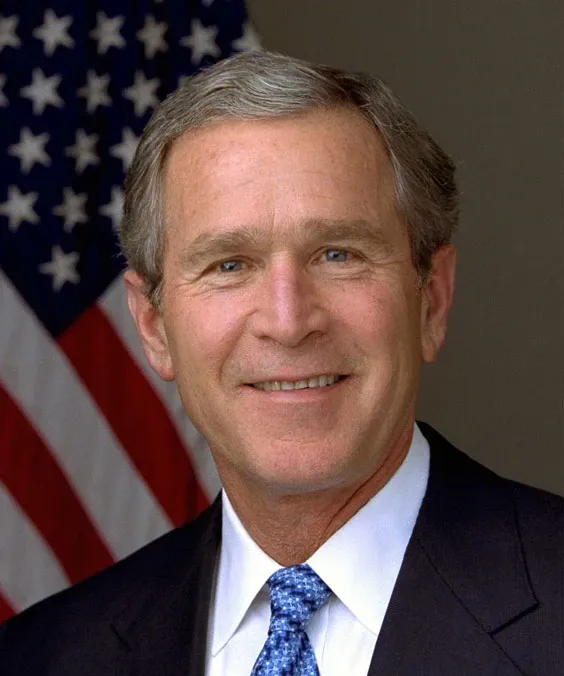
George H.W. Bush was the 41st President of the United States, serving from January 20, 1989, to January 20, 1993. A member of the Republican Party, he previously held the office of Vice President under Ronald Reagan from 1981 to 1989. Bush was a World War II veteran and served in various roles within the U.S. government, including as Director of the Central Intelligence Agency from 1976 to 1977. His presidency is noted for significant events such as the Gulf War and the fall of the Berlin Wall, as well as his efforts in foreign policy and international diplomacy.
Well, as you may know, I left out one meeting, and that is that I did meet with the Soviet Ambassador here following the Gorbachev call. But whether President Gorbachev and I talk again I'm not--we didn't set a time. Perhaps we will. We've…
With United Nations Secretary-General Javier Perez de Cuellar Concerning the Persian Gulf Crisis January 10, 1991 The President spoke with U.N. Secretary-General Perez de Cuellar late this afternoon to discuss the Secretary-General's…
I still feel that it would be very helpful to the last step for peace if the Congress would move and would support the so-called U.N. resolutions that are before the House now and will be before the Senate.
I had every opportunity to express the forcefully and long-held view of the United States on that question.
The United States feels that the use of force particularly in the Baltics would be counterproductive.
I think I can do this without fear of contradiction -- they are absolutely convinced that Saddam Hussein should get out of Kuwait in total compliance with the U.N. resolutions.
I think the very fact he called in the true spirit of consultation says a lot not just about the U.S.-Soviet relationship but about the fact that it is not simply Iraq versus the United States; it is Iraq, indeed, versus the whole world.
All stages of human life are precious; all demand recognition of their sanctity.
We must recognize the dignity and worth of every human being in our laws, as well as in our hearts.
We've had a very interesting morning here and a very interesting phone call with President Gorbachev.
That is too hypothetical a question for me to answer. We are prepared to do what we need to do to fully implement 678. And I would think that he'd think long and hard before he started yet another war. There is one war on--that's his war…
I can't be more specific, but I can be that he will get out of Kuwait, and he will get out of Kuwait entirely, and he will get out of Kuwait without concession. That, I think, is the underlying part of the message.
A followup question. I'm sorry, I'm going to have one more, and then Charles [Charles Bierbauer, Cable News Network]--I told him, and then I'm leaving. Thank you very much, though.
And it has since August 2d--exactly. Because this aggression is not going to stand. And there's an awful lot at stake in terms of the new world order that it doesn't stand. And there's a lot at stake in terms of a lot of human life in…
I'm not sure I have great hope for it. But I think when human life is at stake, you go the extra mile for peace. And that's what we have tried to do. And I will continue to think of reasons--I told President Mitterrand, I said, look, if…
I think he's wrong on all of his assumptions about what would happen if it came to war--God forbid. In the middle, and back here. And then we've got three more, and then I've got to go. These--Ellen [Ellen Warren, Knight-Ridder]?
I'm not sure. What would a mission of Jim Baker have been? It might have been to convince the man that he is up against an immovable force. He's up against something that is not going to yield. He is up against a situation under which…
The foreign ministers of the EC have been very solid, and so has President Francois Mitterrand, that there will be no linkage. So you're asking me a hypothetical question that I won't have to answer because he's not going to do that.
And I think it enhances the peace. I really believe, John [John Cochran, NBC News], that he is living under a delusion. I think he doesn't think that force will be used against him. I think he's misinterpreted the debate. I also think he's…
There have been 200--I'll just repeat for the record that there have been a lot of uses of force in our history and very few declarations of war. But I have tried. I have done more consultation with the Congress than any other President…
I don't think I need it. I think Secretary Cheney expressed it very well the other day. There are different opinions on either side of this question, but Saddam Hussein should be under no question on this: I feel that I have the authority…
I think it was after he had made that--I think it was after the letter had been rejected at the table there in Geneva. Just one more effort to try to get this direct communication to him. I'm not sure on that, but I believe that's correct.
----so when he talked about his allies there, I don't know who stood up at the General Assembly of the United Nations and stood against the resolution that so overwhelmingly passed condemning Iraq. So, there will be no linkage, put it that…
No, I wouldn't make it. And we oppose linkage. The coalition opposes linkage. And the argument with Saddam Hussein is about Kuwait. It is about the invasion of Kuwait, the liquidation of a member of the United Nations, a member of the Arab…