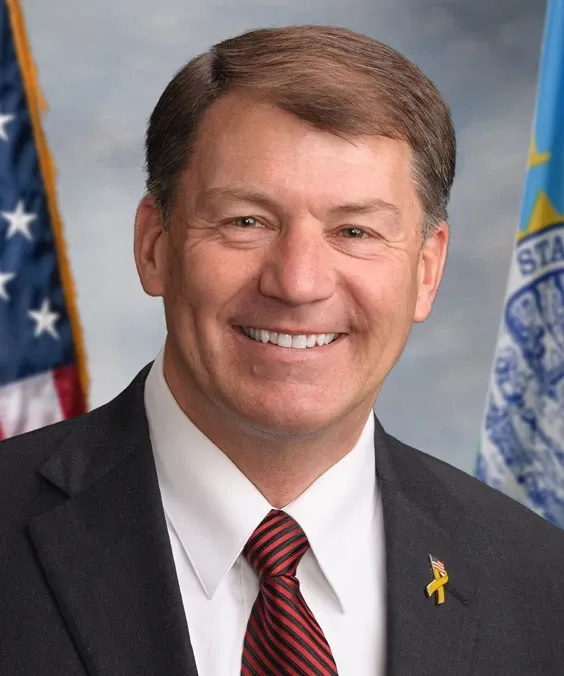
Dusty Johnson
The Public Record
Dusty M. Johnson is a Republican politician currently serving as the U.S. Representative for South Dakota's at-large congressional district, a position he has held since January 3, 2019. Prior to his election to Congress, Johnson served on the South Dakota Public Utilities Commission and was a member of the South Dakota House of Representatives. His legislative focus includes issues related to agriculture, energy, and rural development, reflecting the interests of his constituents in South Dakota.
Jun 19, 2019
I am interested in working with you to root out waste, fraud, and abuse wherever it is.
Jun 19, 2019
We have to find a way to make sure that hungry people can eat all of the time.
Jun 19, 2019
There are times when broad-based categorical eligibility is, frankly, an embarrassment.
Jun 19, 2019
It is wet in farm country. In fact, our corn planting is so far behind that many South Dakota producers aren't quite sure how they are going to feed the 5 million cattle that are in our State. Now, these producers don't want a new…
Jun 19, 2019
Now, there are allegations seemingly every day on the floor of the House that my party doesn't authentically care about poor people.
Jun 19, 2019
Ninety-nine percent of them will continue to qualify or be eligible for that program.
Jun 3, 2019
First off, we should be clear that it is the law of the land in my understanding since the 1996 Welfare Act that able-bodied SNAP recipients should work.
Jun 3, 2019
I am introducing the Farm and Ranch to School bill, which would allow for a greater portion of that budget to be used on locally sourced beef, bison, and other meats.
Jun 3, 2019
I know I am not lazy. I know I grew up as a poor boy in South Dakota, I know my life is better because I was held accountable by parents, by teachers, by the laws and regulations and rules of a society.
Jun 3, 2019
I don't think that holding people accountable is punishment. I think it is a hallmark of a responsible society.
May 7, 2019
In the 1960s, South Dakota's Ben Reifel became the first Lakota Indian to represent our country in Congress. He grew up dirt poor in a log cabin. He dropped out after the eighth grade, later going on to graduate from South Dakota State and…
May 2, 2019
In 1961, South Dakota's Ben Reifel became our Nation's first Lakota Indian in Congress. He grew up dirt poor in a log cabin in rural Todd County. He dropped out after eighth grade but later graduated from South Dakota State and from…
Apr 9, 2019
I am honored to be a part of this Special Order tonight. I want to highlight the dire situation in my home State of South Dakota. Our State is just barely beginning to recover from dramatic flooding while, simultaneously, we are trying to…
Apr 2, 2019
No, absolutely, and I think that is what is concerning about the way the waivers operate right now...
Apr 2, 2019
Work does that, and if a couple of things came out loud and clear that there is basis for agreement, it is first off that people who can work, should work.
Apr 2, 2019
The term able-bodied, as we have talked about, is so key to this discussion, and I want to make sure that we are working to empower and not stigmatize the ABAWD population.
Apr 2, 2019
Second, that SNAP is an important poverty program. That is something worth maintaining, something worth holding up.
Apr 2, 2019
For me, an important foundation of all of this Subcommittee's work on nutrition is, first, that we all want to improve the lives of Americans who are facing hard times.
Apr 2, 2019
Third, that work and education are a critically important, a necessary part of helping people realize opportunities to move out of poverty.
Apr 2, 2019
That is not leadership. And so, let's work with SNAP recipients. Let's work with this Subcommittee. Let's work with the Administration to move even more people from welfare to work.
Apr 1, 2019
If the unanimous consent cannot be entertained, I would then urge the Speaker and the majority leader to immediately---- The SPEAKER pro tempore. The gentleman has not been recognized for debate. ____________________
Apr 1, 2019
I rise this evening to request unanimous consent that the Committee on the Judiciary be discharged from any further consideration of H.R. 962, the Born-Alive Abortion Survivor Protection Act, and I ask that it be taken up for immediate…
Politicians like Dusty Johnson