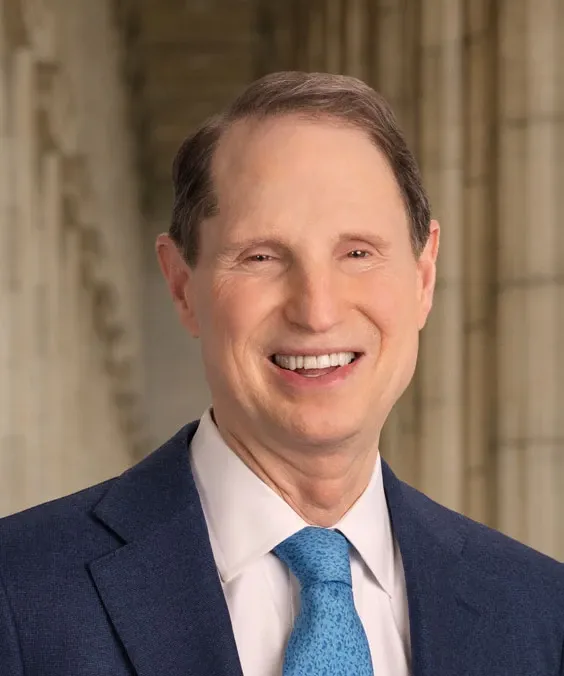
Jeff Merkley
The Public Record
Jeff Alan Merkley is an American politician serving as the junior United States senator from Oregon since January 6, 2009. A member of the Democratic Party, Merkley has focused on issues such as healthcare, climate change, and economic inequality throughout his tenure. He has been an advocate for progressive policies and has worked to address the challenges facing working families in Oregon and across the nation. Merkley is known for his commitment to transparency and accountability in government, often speaking out against perceived injustices and advocating for reforms.
Mar 3, 2015
I really celebrate this type of partnership between the goal of conservation and the practices of local ranchers.
Mar 3, 2015
That creates an enormous inefficiency and failure to pursue many of the goals that we have laid out in the budget.
Mar 3, 2015
Should we not succeed in doing it, it could be a catastrophe in many, many ways, for all of the stakeholders.
Feb 23, 2015
I appreciate the administration putting forward the AUMF. I think it is our responsibility under our Constitution to wrestle with it.
Feb 23, 2015
I would like to see us put a timeframe on 2001, despite, as you point out, that there is an enduring threat.
Feb 23, 2015
We have to understand that all our lives, the danger, the uncertainty, the need for alertness, for effort, that discipline will be upon us.
Feb 10, 2015
Thank you. And I will mention in my last few seconds here that the pilot project in Talent Irrigation District with Bear Creek, the funding is much appreciated.
Feb 10, 2015
I just want to make sure that the economy of our Oregon coast doesn't shut down, as it has come close to a number of times when dredging was not funded.
Feb 10, 2015
I just wanted to draw it to your attention and say, in this first year of implementation of this agreement, after decades of fighting over the water, how important it will be for us to make sure that it happens in a timely and competent…
Feb 10, 2015
I look forward to hearing their testimony and exploring ways that we can maximize the effectiveness of their good work on the ground.
Feb 10, 2015
Your plan allows partnerships to occur between States as another form of flexibility?
Feb 10, 2015
Currently, we are on a path where our carbon pollution has gone up to 400 ppm, up from about 270 ppm for the industrial revolution.
Feb 10, 2015
Thank you for bringing forward a plan that encourages each State to find the most cost effective, flexible way of taking on carbon dioxide.
Feb 10, 2015
Part of the conversation we are having, as initiated by the Chair, was how the U.S. changes operate in the context of a global challenge.
Feb 10, 2015
Certainly we have benefited, if you will, from utilizing fossil fuels on a scale much larger than individual citizens in China or India.
Feb 10, 2015
We are having substantial droughts, three of the worst ever droughts in the Klamath Basin in just the last decade and a half.
Feb 10, 2015
That commitment came out of a dialog with China about the need for all the nations of the world to proceed to take on this issue?
Feb 10, 2015
I thank you for putting forward a plan that helps put the United States in the leadership role of working with the nations of the world to take on this devastating challenge.
Feb 10, 2015
This is something having a huge impact on our economy, on our rural way of life, on our fishing, our farming and our forests right now.
Feb 9, 2015
These rules become part of an examination process that just is a burden and misappropriately applied.
Feb 9, 2015
I think you have gotten to the core of the type of feedback loop that is so important.
Jan 27, 2015
Wealthy Americans should not pay the same marginal tax rate that working Americans pay.
Politicians like Jeff Merkley