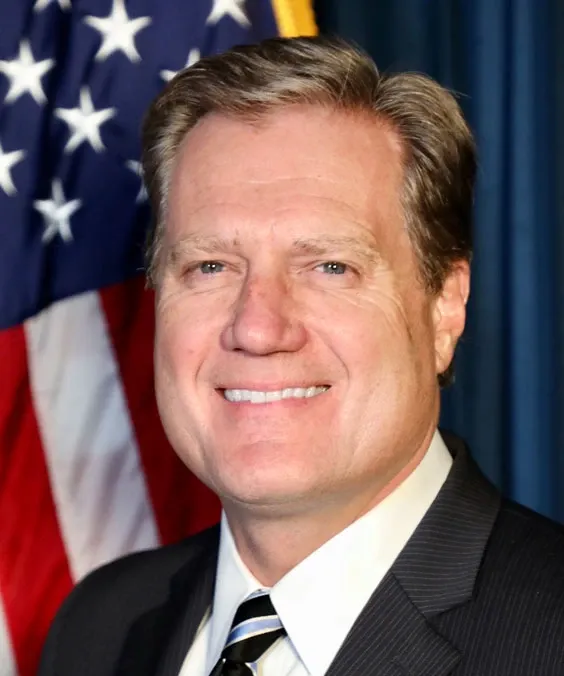
I want to know is do you agree with your Department's position and the Administration's position that putting on the World War II Memorial Franklin Roosevelt's D-Day prayer will necessarily dilute the central message of the World War II…
Bill Johnson
The Public Record
Bill Leslie Johnson is an American politician and member of the Republican Party who has served as the U.S. Representative for Ohio's 6th congressional district since January 5, 2011. He has been involved in various legislative efforts during his tenure, focusing on issues such as energy policy, healthcare, and economic development. Johnson has been an advocate for conservative principles and has worked to promote job creation and support for local businesses in his district. He has also served on several committees, contributing to discussions on national security and veterans' affairs.

Do you agree with your Department's testimony that it will dilute the central message of the World War II Memorial?
The national unemployment rate is 9.1% and there is very little proof this number will improve in the coming months.
Like many of the proposals my colleagues and I have put forth in this Committee, the Keystone Pipeline project will help our nation reduce our dependency on sometimes hostile foreign sources of energy.
However, this ill-advised and purely political decision by the President will do more than just domestic economic harm, but it will have grave national security implications as well.
You are going to filibuster, just like you have done so many other times today, and you are not going to answer the question.
Placing the President's prayer, D-Day prayer, on the World War II Memorial will necessarily dilute this elegant memorial's central message
I believe it is imperative we take into consideration the national security implications of our energy policy.
This is really a purely political decision by the President that will do more than just economic harm, but it will have a grave national security implication as well.
How are you going to get the Chinese to buy them when the Chinese are subsidizing the prices of those products domestically?
It seems to me that giving the Chinese Government American aid at the expense of the American taxpayer to try and force compliance is an ill-advised strategy.
I disagree with that, but I can assure you I am new. This is my first term. But if that is true, then I am going to work hard to change the direction because we are spending American taxpayer dollars irresponsibly on this program.
Why aren't we using the money that we are giving to China to help spur the U.S. economy and job growth at home, rather than investing it in China?
That they don't know. You don't know what the implications are to American companies until after you have implemented these policies.
You know, I don't think you guys have the memo about what your President, our President, said in his State of the Union.
It is amazing to me that we sit and listen to my colleague from Massachusetts talk about how dismal of a performance this contractor did, and yet he wasn't fired.
Did any official at OSM or the Interior or any part of the Administration ask that contractor to change the assumptions for the economic analysis which would then lower the jobs impacts of their analysis?
He thinks OSM seems to want to complete this rulemaking process at a world record pace, which is unrealistic considering the other one took 5 years to complete.