Thus we see the use of a sort of 'preliminary' age in societies, when trade is bad because it prevents the separation of nations, because it infuses distracting ideas among occupied communities, because it 'brings alien minds to alien…
Walter Bagehot
The Public Record
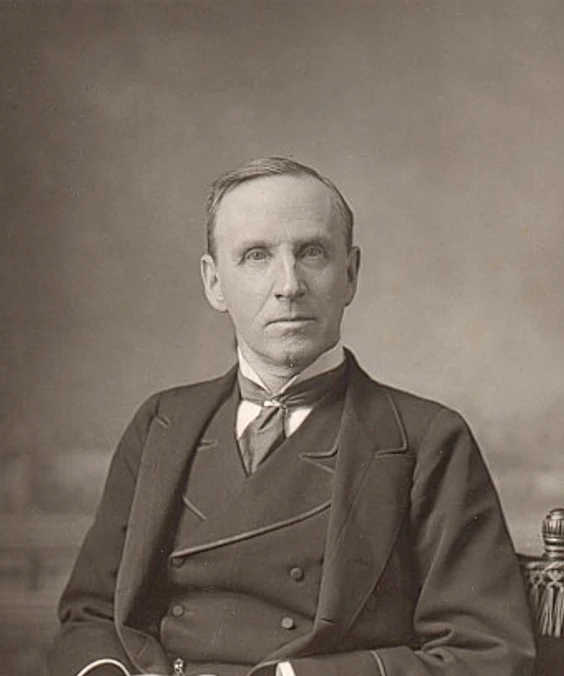
Walter Bagehot was an English journalist, businessman, and essayist, who wrote extensively about government, economics, literature and race. He is known for co-founding the National Review in 1855, and for his works The English Constitution and Lombard Street: A Description of the Money Market (1873).
gutenberg.org
And as the trade which we now think of as an incalculable good, is in that age a formidable evil and destructive calamity; so war and conquest, which we commonly and justly see to be now evils, are in that age often singular benefits and…
It is only by the competition of customs that bad customs can be eliminated and good customs multiplied.
Conquest is the premium given by nature to those national characters which their national customs have made most fit to win in war, and in many most material respects those winning characters are really the best characters.
Similarly, the best institutions have a natural military advantage over bad institutions.
The first great victory of civilisation was the conquest of nations with ill-defined families having legal descent through the mother only, by nations of definite families tracing descent through the father as well as the mother, or…
The nations with a thoroughly compacted family system have 'possessed the earth,' that is, they have taken all the finest districts in the most competed-for parts; and the nations with loose systems have been merely left to mountain ranges…
The savage subjected to a mean superstition, is afraid to walk simply about the world--he cannot do THIS because it is ominous, or he must do THAT because it is lucky, or he cannot do anything at all till the gods have spoken and given him…
But under the higher religions there is no similar slavery and no similar terror.
They all enabled those who believed them 'to take the world as it comes,' to be guided by no unreal reason, and to be limited by no mystic scruple; whenever they found anything to do, to do it with their might.
And more directly what I may call the fortifying religions, that is to say, those which lay the plainest stress on the manly parts of morality--upon valour, on truth and industry--have had plainly the most obvious effect in strengthening…
Every nation, is an 'hereditary co-operative group,' bound by a fixed custom; and out of those groups those conquer which have the most binding and most invigorating customs, and these are, as a rough rule, the best customs.
The majority of the 'groups' which win and conquer are better than the majority of those which fail and perish, and thus the first world grow better and was improved.
If human nature was to be gradually improved, each generation must be born better tamed, more calm, more capable of civilisation--in a word, more LEGAL than the one before it, and such inherited improvements are always slow and dubious.
Though a few gifted people may advance much, the mass of each generation can improve but very little on the generation which preceded it; and even the slight improvement so gained is liable to be destroyed by some mysterious atavism--some…
Long ages of dreary monotony are the first facts in the history of human communities, but those ages were not lost to mankind, for it was then that was formed the comparatively gentle and guidable thing which we now call human nature.
It was 'government by discussion ', which broke the bond of ages and set free the originality of mankind.
Success in life, then, depends, as we have seen, more than anything else on 'animated moderation,' on a certain combination of energy of mind and balance of mind, hard to attain and harder to keep.
It is a matter of common observation that, though often separated, fine taste and fine judgment go very much together, and especially that a man with gross want of taste, though he may act sensibly and correctly for a while, is yet apt to…
In this way the union between a subtle sense of beauty and a subtle discretion in conduct is a natural one, because it rests on the common possession of a fine power, though, in matter of fact, that union may be often disturbed.
A complex sea of forces and passions troubles men in life and action, which in the calmer region of art are hardly to be felt at all.
And, therefore, the cultivation of a fine taste tends to promote the function of a fine judgment, which is a main help in the complex world of civilised existence.
Nature does not wear her most useful lessons on her sleeve; she only yields her most productive secrets, those which yield the most wealth and the most 'fruit,' to those who have gone through a long process of preliminary abstraction.
And yet it is on these out-of-the-way investigations, so to speak, that the art of navigation, all physical astronomy, and all the theory of physical movements at least depend.
If there were no 'Bradshaw' and no one knew the time at which trains started, a man who caught the express would not be a wiser or a more business-like man than he who missed it, and yet he would arrive whole hours sooner at the capital…
Politicians like Walter Bagehot