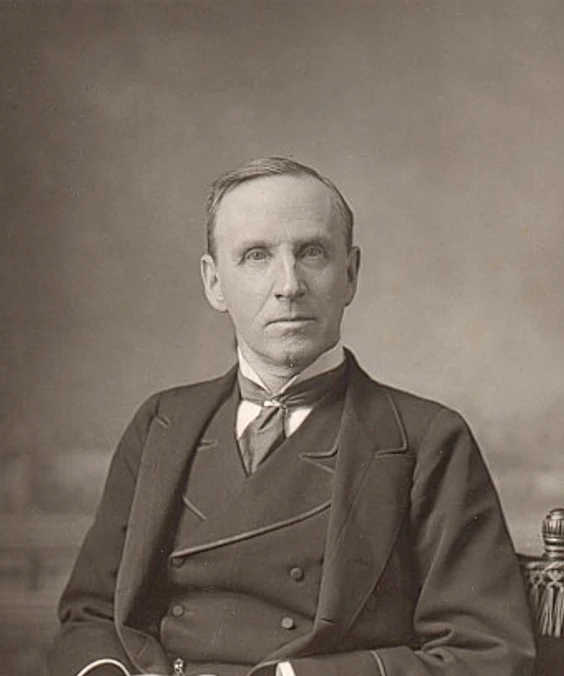
We should agree that crime is a matter for the state, and sin a matter for the churches.
Harold J. Laski
The Public Record
Harold Joseph Laski was an English political theorist and economist. He was active in politics and served as the chairman of the British Labour Party from 1945 to 1946 and was a professor at the London School of Economics from 1926 to 1950. He first promoted pluralism by emphasising the importance of local voluntary communities such as trade unions. After 1930, he began to emphasize the need for a workers' revolution, which he hinted might be violent. Laski's position angered Labour leaders who promised a nonviolent democratic transformation. Laski's position on democracy-threatening violence came under further attack from Prime Minister Winston Churchill in the 1945 UK general election, and the Labour Party had to disavow Laski, its own chairman.
gutenberg.org
We should admit that there must be uniform regulations for marriage and divorce, but that individuals only could make up their minds when, within the regulations, either to marry or divorce.
The purpose for which authority is exercised is the maximum satisfaction of desire.
To achieve that end, it is in the long run vital to take account of the wills of those who will be affected by the decision.
Maximum satisfaction, in other words, is a function of maximum consultation; and the greater the degree in which the citizen shares in making the rules under which he lives, the more likely is his allegiance to those rules to be free and…
The process of being consulted gives him a sense of being significant in the state.
It makes him feel that he is more than the mete recipient of orders.
He realizes that the state exists for his ends and not for its own.
He comes to see that his needs will be met only as he contributes his instructed judgment to the experience out of which decisions are compounded.
He gains the expectation of being consulted, the sense that he must form an opinion on public affairs.
He learns to dislike orders which are issued without regard being paid to his will.
He comes to have a sense of frustration when decisions are made arbitrarily, and without an attempt to build them from the consent of those affected.
Those who are trained to that vigilance become the conscious guardians of liberty.
In any community, fortunately for ourselves, power is always upon the defensive; and when men are vigilant to expose its encroachments it is urgent to seek their good opinion.
Those active-minded enough to fight for their rights will, doubtless, be always in a minority; but they prick the indifferent multitude into thought and they thus act as the gadflies of liberty.
To accustom the average man to regard himself as a person who must be consulted is, in the long run, to assure him, through consultation, of satisfaction.
For the notion that, when the citizen has chosen his representatives for Parliament or his local authority, he can sit back in the comfortable knowledge that his wants are known, his interests safeguarded, has not one jot of evidence to…
Its value both as a check upon bureaucracy, and as a means of making decision genuinely representative in character, becomes the more clear the wider our experience of its functioning.
There will never be liberty in any state where there is an excessive concentration of power at the centre.
If the decisions to be made are to embody the needs of those affected by them, the latter must have major responsibility for their making.
All of our problems are not central problems; and to leave to the central government the decision of questions which affect only a portion of the community is to destroy in that portion the sense of responsibility and the habit of…
The inhabitants of any given area have a consciousness of common purposes, a sense of the needs of their neighbourhood, which only they can fully know.
They find that the power to satisfy them of themselves gives to them a quality of vigour far greater in the happiness it produces than would be the case if satisfaction were always provided by, or controlled from, without.
For administration from without always lacks the vitalizing ability to be responsive to local opinion; it misses shades and expressions of thought and want which are urgent to successful government.
But we cannot understand the eighteenth century, or its theories, unless we realize that its temper was still dominantly aristocratic.
Politicians like Harold J. Laski