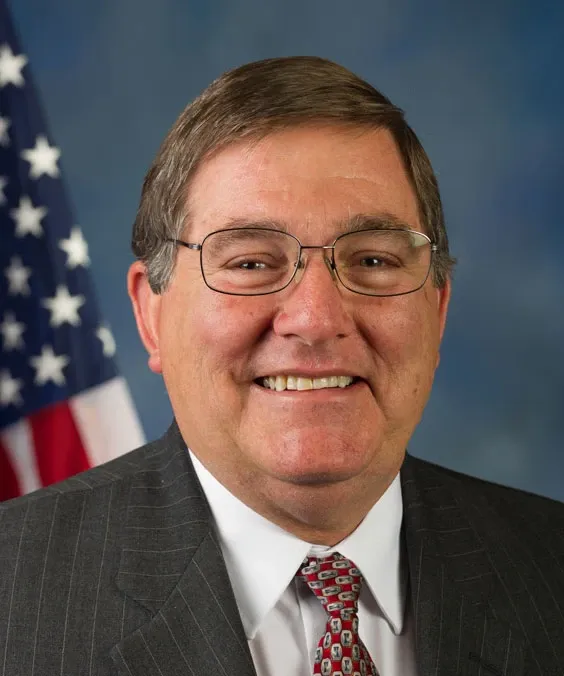
Jeb Hensarling
The Public Record
Jeb Hensarling is a former Republican member of the United States House of Representatives, representing Texas's 5th congressional district from 2003 to 2019. During his tenure, he served as the chairman of the House Financial Services Committee, where he played a significant role in shaping financial regulation and policy. Hensarling was known for his advocacy of free-market principles and his opposition to the Dodd-Frank Act, which was enacted in response to the 2008 financial crisis.
Jun 24, 2014
My part is to do the best I can for my district and support an investment that creates 1,000 jobs in my district.
Jun 24, 2014
I think the blow to our economy by suddenly ending Export-Import, putting small businesses and also larger businesses at risk is, especially at this time, when we still have not fully recovered from the crash of 2008...
Jun 24, 2014
The taxpayer money goes overseas to China and Russia, nations that openly challenge our economic and security interests.
Jun 24, 2014
Obviously, it is taxpayers' money--the cashier at the corner grocery store, the cop on the beat, your children's teachers, the small business owner struggling to keep the doors open in a tough economy.
Jun 24, 2014
Overwhelmingly and indisputably, it is some of the largest, richest, most politically connected corporations in the world, like Boeing, General Electric, Bechtel, and Caterpillar.
Jun 23, 2014
I just don't believe that a trade context is the appropriate place to resolve those matters.
Jun 23, 2014
This is a sad disservice to the American people the way this crisis has been handled.
Jun 23, 2014
The arrogance that the Administration has shown, that the IRS has shown, that Treasury has shown with regard to this investigation is unbelievable.
Jun 23, 2014
What we have said is that if the talks break down, if Iran is not willing to make concessions, we will look for tougher sanctions, and we will take no option off the table to make sure Iran does not get nuclear weapons.
Jun 23, 2014
The Volcker Rule will significantly reduce liquidity in the corporate bond market.
Jun 23, 2014
Mr. Secretary, this stonewalling by you and this Department must stop. We have to get real answers from you and from Treasury, and I hope that today, the process begins.
Jun 23, 2014
The American people, regrettably but understandably, are becoming increasingly cynical and fearful of their government.
Jun 23, 2014
It is unacceptable to be in a place where 'too-big-to-fail' has not been ended.
Jun 17, 2014
I think a lot about how it impacts my children, particularly when I gaze upon them.
May 19, 2014
We need to move past these ambiguous thresholds and change the regulatory agencies, charge them with determining the financial risk to the system based on the riskiness of their operations.
May 19, 2014
I would urge the Council to make every effort to conduct its review in a manner that maximizes transparency and accountability.
May 19, 2014
Federal agencies now have virtually unfettered discretion to expand their regulatory control through a designation process that is opaque, secretive, vague, open-ended, and highly subjective.
May 19, 2014
The Dodd-Frank Act represents a breathtaking outsourcing of legislative power to the Executive Branch.
May 19, 2014
FSOC is about one thing: increasing Washington's control over the U.S. economy, thus curtailing both economic freedom and economic prosperity.
May 19, 2014
I suppose there is a possibility their representatives fell asleep during the proceedings and neither objected or consented.
Politicians like Jeb Hensarling