
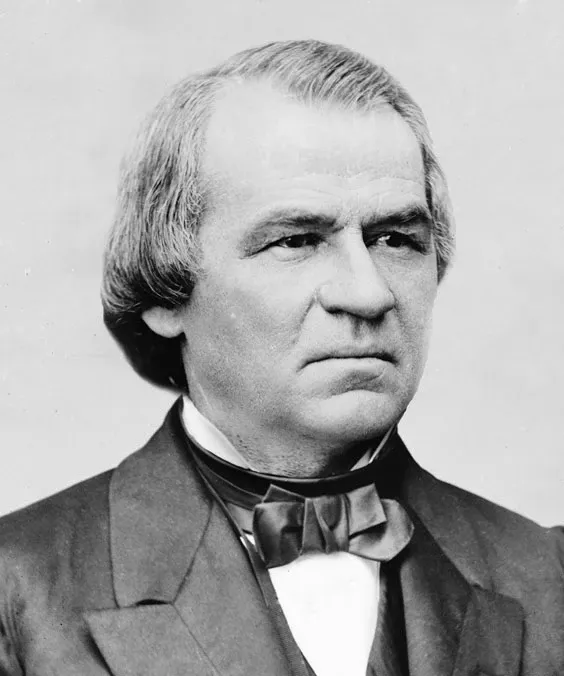
@andrewjohnson· Democratic · TN· Apr 9, 1867
It is not believed that the approval of any bill after the adjournment of Congress, whether presented before or after such adjournment, is authorized by the Constitution of the United States.
On the record
Quotes from current and former Vice Presidents.
Current vice presidents
Former vice presidents
It is not believed that the approval of any bill after the adjournment of Congress, whether presented before or after such adjournment, is authorized by the Constitution of the United States.
This bill will therefore be filed in the office of the Secretary of State without my approval.
I consider this limitation as a very necessary check against unlimited expenditure and liabilities.
I, Andrew Johnson, President of the United States, have considered it to be my duty to issue this my proclamation
I feel bound to approve this resolution, without modifying in any manner any objections heretofore stated against the original and supplemental acts.
An extraordinary occasion requires the Senate of the United States to convene for the transaction of business at the Capitol, in the city of Washington, on Monday, the 1st day of April next, at 12 o'clock on that day
I transmit to the Senate, for its consideration with a view to ratification, a treaty between the United States and His Majesty the Emperor of all the Russias upon the subject of a cession of territory by the latter to the former, which…
To the Senate of the United States: I transmit to the Senate, in answer to their resolution of the 20th instant, a report from the Secretary of State, with accompanying documents.
I confidently believe that a time will come when these States will again occupy their true positions in the Union.
All this legislation proceeds upon the contrary assumption that the people of each of these States shall have no constitution except such as may be arbitrarily dictated by Congress and formed under the restraint of military rule.
A military republic, a government rounded on mock elections and supported only by the sword, was nearly a quarter of a century since pronounced by Daniel Webster, when speaking of the South American States, as 'a movement, indeed, but a…
If ever the American citizen should be left to the free exercise of his own judgment it is when he is engaged in the work of forming the fundamental law under which he is to live.
When this shall have been consummated, I pray God that the errors of the past may be forgotten and that once more we shall be a happy, united, and prosperous people, and that at last, after the bitter and eventful experience through which…
I have considered the bill entitled 'An act supplementary to an act entitled 'An act to provide for the more efficient government of the rebel States,'' passed March 2, 1867, and to facilitate restoration.
No consideration could induce me to give my approval to such an election law for any purpose, and especially for the great purpose of framing the constitution of a State.
I herewith lay before the Senate, for its constitutional action thereon, a treaty concluded on the 19th of March, 1867, between the United States and the Chippewa tribe of Indians of the Mississippi.
A letter of the Secretary of the Interior and a copy of a letter of Hon. Lewis V. Bogy, special commissioner, of the 20th instant, explanatory of the said treaty, are also herewith transmitted.
I transmit to the House of Representatives, in answer to their resolution of the 18th instant, a report from the Secretary of State, with an accompanying paper.