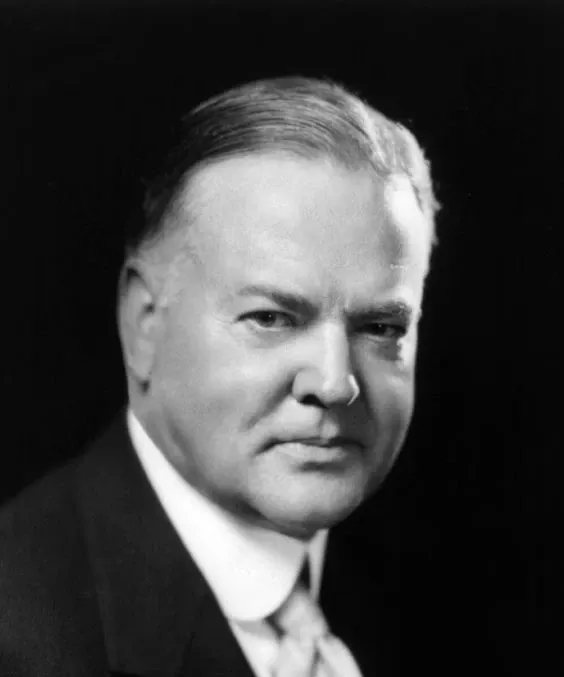
@herberthoover· Republican · CA· Jun 23, 1932
There is another phase of the bill as passed which is disheartening.
On the public record
Every politician on the site, every statement on file. Search, filter, and read the public record.
111,600+·quotes on file
There is another phase of the bill as passed which is disheartening.
Any study of many of these public works provisions will indicate plainly their pork-barrel characteristics.
We cannot restore employment in the United States by these methods.
I earnestly hope that this may be done.
The details of this estimate, the necessity therefor, and the reason for its transmission at this time are set forth in the letter of the Director of the Bureau of the Budget transmitted herewith, with whose comments and observations…
While these features in the Wagner and the Garner bills are not in the form and are not as well safeguarded as they should be, they are in line with major objectives I have been advocating.
It is not intended by this order to give any publicly owned lands a national-forest status which have hitherto not had such status, nor to remove any publicly owned lands from a national-forest status.
This order shall be effective from July 1, 1932.
Under authority of the act of Congress approved June 4, 1897 (30 Stat. 11, 36; U.S. Code, title 16, sec. 473), and on the recommendation of the Secretary of Agriculture, it is hereby ordered that lands within the Toiyabe National Forest…
The Secretary of State may grant and issue passports, and cause passports to be granted, issued, and verified in foreign countries by diplomatic representatives of the United States
The Kellogg-Briand Pact, to which we are all signatories, can only mean that the nations of the world have agreed that they will use their arms solely for defense.
We have no desire for offensive armament.
That the validity of a passport . . . shall be limited to a period of two years.
I propose the adoption of the presentation already made at the Geneva Conference for the abolition of all tanks, all chemical warfare, and all large mobile guns.
The time has come when we should cut through the brush and adopt some broad and definite method of reducing the overwhelming burden of armament which now lies upon the toilers of the world.
No such suggestion has ever been made by any American official.
This reduction should be carried out not only by broad general cuts in armaments but by increasing the comparative power of defense through decreases in the power of the attack.